BOTTLED

  • “Sometimes the questions are complicated and the answers are simple. Dr. Suess

Wednesday, June 23, 2010

T-M-I

Did you ever see a coach signal ‘time out’? It’s a distinctive hand signal.

I see it used mostly in jest between peers, among many that are younger than I am, as in “TOO MUCH INFORMATION”! – STOP - that is too personal, too complicated or not really what I asked - accompanied with the statement T-M-I !!!

Some days I wish I could do that – signal ‘time out’ – TMI – I don’t want to know - except I do. I just wish I didn’t. Basically I am of a decently curious ilk but there are things I don’t think about, search out or learn until it affects me personally.

Being diagnosed with possible ‘sarcoma’ is one of those things – are you serious? POSSIBLE! really? Oh – and now the specialist of specialists thinks this thing (15cm x 9cm x 8cm – visualize your two fists side by side and fit them into a muscle in your thigh) is definitely NOT a sarcoma but is only a benign atypical lipoma – am I supposed to shout for joy? Kiss the clinically sterile pronouncing face in relief? What do you do with this kind of news – of both kinds?

I learn things I never really wanted to know. I ask for second and even third opinions. And then I make decisions – decisions I never really wanted to need to make.

If you don’t want to know, TMI, click the X at the top of the page now. Below is actually the good news – and TMI.

And BTW – if this isn’t TMI simply copy any one of the terms below into your browser and then click on every linked word you see – you should be able to reach your personal TMI threshold easily.

The division of cells to produce new ones is under tight control by the "genes" within each cell. These genes are made up of DNA, and if it becomes damaged, that cell may start dividing out of control. Soft Tissue Cancer starts in a single cell which has become abnormal. This cell produces millions, and eventually billions, of copies of itself. The copies are called" clones". These clones fail to function as normal body tissue, but instead divert resources from healthy cells to fuel their own growth. When there are about 1 billion cells, they form a clump, or "tumor" 1/2 inch across. A "tumor" merely means a swelling; it can be caused by infection, inflammation, cancer or whatever.


If a tumor can only grow in its local area (even very large) but does not have the capacity to spread to distant body areas, it is called "benign" and is not cancer. If, however, the tumor has the ability to spread to distant body areas, it is called "malignant" and this is cancer. The actual process of spread is called" metastasis", and can occur to any area of the body.

For benign Soft Tissue tumors, they are commonly given the suffix "oma" . The most common types of benign tumor are "Lipoma " (from fat), "Leiomyoma " (from smooth muscle) and "Fibroma " (from fibrous tissue). These benign tumors may grow very large, but they will never "metastasize" (spread distantly) and so are not considered "cancer". Simply removing them surgically should be curative, and if surgery is not practical then radiation therapy will often shrink them. Unless they are disturbing body function or cosmetic appearance, they often require NO THERAPY.

For malignant Soft Tissue tumors, they are commonly given the suffix"sarcoma." This means a cancer that has arisen from the mesenchymal tissue, as opposed to "carcinomas", which develop from the body's lining tissues and organs. Any tumor that is called a "sarcoma" is cancerous, but not all cancerous mesenchymal tumors end with "sarcoma ”. However, the common ones do, and include "Liposarcoma"(from fat cells), "Rhabdomyosarcoma" (from skeletal muscle cells), "Leiomyosarcoma" (from smooth muscle cells), "Fibrosarcoma" (from fibrous cells) and "Chondrosarcoma" (from cartilage cells). "Osteosarcoma" is the most common bone cancer, but is not considered a"Soft Tissue Sarcoma" and is discussed as a "Primary Bone Tumor."

 Other, rarer types of Soft Tissue Sarcoma (which may or may not have the word "sarcoma" in them) include "Angiosarcoma" (divided into Hemangiosarcoma and Lymphangiosarcoma-- from blood or lymph vessels), "Hemangiopericytoma"(also from a blood vessel cell),"Mesothelioma" (from abdominal or lung linings), "Synovial Sarcoma" (from joint linings), "Neurofibrosarcoma" (from nerve sheaths), "Kaposi'sSarcoma (origin uncertain) and "Malignant Fibrous Histioctyoma" (from fibrous tissue). Some of the above are more aggressive than others, but they are all cancer!

How Common is Soft Tissue Sarcoma?
Each year in there about 8,000 new cases of "Soft Tissue Sarcoma" in the United States, which cause approximately 2,500 deaths per year. Thus, they represent ~1% of all new cancers. Soft Tissue Sarcoma is about 3 times more common than Bone Sarcoma. There are two "peaks" of most common patient age, one in childhood at 10 years old and the other in 40 year old adults. Thus Sarcomas are unlike the other major type of cancer, "Carcinomas" (e.g. breast, lung, prostate, colo-rectal) which all tend to get more likely as we age. Males and Females are overall equally affected by Sarcomas. In children, the most common type of Soft Tissue Sarcoma is "Rhabdomyosarcoma" (from skeletal muscle cells), which occur mostly in the Head and Neck areas. In adults, the most common type is now "Fibrosarcoma"or "Malignant Fibrous Histiocytoma", which tends to occur in the trunk or extremities. In contrast to childhood cases, the least common area for adult sarcomas is in the Head and Neck area. Overall, the number of new cases of Soft Tissue Sarcoma has remained stable for the past 3 decades.

The common underlying factor is damage to "DNA" which causes the affected cell to become "transformed" -- that is lose control over it's division. Cancer is ultimately a disease of the DNA! The DNA is packed into thousands of "genes", which are themselves located upon the 48 "chromosomes" (46 general plus 2 sex chromosomes) that all healthy humans have in every cell. The chromosomes become visible under an ordinary light microscope when cells divide, and nearly every case of Sarcoma shows chromosome damage. This damage usually includes pieces missing from chromosomes ("deletions"), or even parts of one chromosome getting stuck onto another ("translocations").  Overall, anything which can damage DNA, the fundamental genetic material, will increase the risk of a cell turning cancerous. This damage may be "latent", meaning a cancer may arise many years or decades after the damage occurs.

Can Sarcomas Be Prevented?
There is no sure way to prevent sarcomas. It is always a good idea to avoid unnecessary exposure to potential carcinogens and avoid unwarranted X-rays. This is especially true for patients with family susceptibility to cancers, or who actually have genetic diseases.
If a worrisome sign or symptom arises (see below) it should be evaluated promptly, and not ascribed to some benign process without proof. Eating a diet with enough vitamin C ("Ascorbic Acid") is important for proper maintainance and healing of soft tissues. Vitamin C deficiency results in a breakdown of the soft tissues ("scurvy"), since it is essential for crosslinking their crucial collagen proteins. However, taking too much can also be harmful by causing the blood to become too acidic ("ascorbic acidemia"). A standard supplement multi-vitamin is well advised.

The human muscular system is incredibly engineered, providing for body support, movement, and the storage of sugar energy in the form of glycogen. There are 3 basic types of muscle in the body: Skeletal Muscle for voluntary movement, Smooth Muscle for involuntary processes like digestion, and Cardiac Muscle in the heart. Normally the muscles are a very trouble-free system, maintained by simple activity and exercise. Rarely, however, cancers called "sarcomas" arise from muscle. Smooth muscle gives rise to "myosarcoma", and skeletal muscle to "rhabdomyosarcoma". see also: Pleomorphic type or pleomorphism. Usually seen in adults and arises in muscles of the extremities

It is crucial to get prompt diagnosis and proper treatment for a muscle cancer problem. This can make the difference between keeping or losing a limb, or even between life and death. Fortunately, recent advancements in therapy make limb loss less likely, and cure more like, than ever before. Understanding your options for a Muscle Cancer problem will give you the peace of mind of knowing you have done everything possible to help ensure a happy outcome.

'CancerAnswers' material explains, in plain English, the definition, types, frequency, risk factors, symptoms, evaluation, historic and latest effective treatment for Muscle Cancers. We tell you everything you must know to make the right choices today to deal with a Muscle Cancer problem.

Thursday, June 17, 2010

COWS - a diatribe

Long automobile trips are often tediously boring. When I have too much time I think – a lot.

After several monotonous hours of the same rocky dirt and gray green sagebrush a cow was a welcome interesting relief – visually and mentally. I began to watch for more: surely there is more than one lone cow along such a long road. I was rewarded. There were many cows to observe - not that there was much to observe.

What does a cow do?

Cows may be many different colors but not like a rainbow. Cows are generally tones and patches of black and white and a variety of browns shading through reds to every earth tone I have ever imagined. They are the source of many common and useful products such as milk, meat, leather, glue and – well - really, too many more things to list. Even the wastes cows produce are useful to grow verdant crops and gardens.
But what do they do; really - day in, day out - besides exist? 

Every cow I ever see is doing one of a few simple things: standing - chewing a cud or grazing; walking or running - nowhere in particular, for no reason in particular other than perhaps curiosity (except when being chased or seeking food and water) or else lowing – emitting that typical moo moo sound cows make, that occasionally might become loud and insistent enough to be described by my father as bellering. On the farm we saw many cow personalities - some placid, some feisty but most still fit my question. I remember one that didn't. She was a fence hopper. She spent every day hopping fences. Dad tried many tricks to keep her safe but eventually she 'went to a sale' - became 'beef'.

I ruminated upon this concept for a time and it generated a question to alleviate boredom: what do I do?

Now there is a question – am I, as a woman, much different than a cow?
Do I squander my time like a cow in a field chewing her cud and my energy running away from, or to see, curiosities? Am I just to be looked at or am I just making fat – beefing up (or trying to avoid it)? Is my existence of more value than my ‘meat’ - my physical body - or the making of milk, babies or other useful products?

(Men you are not off the hook either. Don’t feel like you don’t qualify as “beef” or at least ‘bull-oney’ – snicker – come on, laugh at yourself. At least cows have high production rates not to mention self replacement value and - BTW – do you let your wife know she is accomplishing more in life than a cow? is worth more in your life? means more to you than the money she earns, the dishes and clothes she washes and the children you share? Does the woman in your life know she is more than a cow?)

I have answers to many of my questions, yet I do measure myself against them.

I am a daughter of God - all women are, so are all men - a child of the Supreme Being Himself and His wife.

My father has many talents and abilities. I have inherited some abilities from him and I have learned many wise and wonderful things from him. What am I capable of learning as a child of God? I can only imagine what I might have inherited or be able to learn from my Father in Heaven. 

I have more going for me than any cow: much more than a drudgery of days – day in, day out - so do you! God loves each and every one of us individually, uniquely and personally. We ARE his children.

I became invigorated to do something more each day than eating and mooing. I became determined to try to avoid things that make me feel like a cow – determined to participate in purposeful engaging productive, planned activity every day.

At a CES Fireside for Young Adults, 3 May 2009 David A. Bednar (also see June 2010 Ensign, pg 22-31) spoke at length about ‘Things As They Really Are’ and appropriate use of our time and physical being and cautioned, “We need to heed the admonition of Paul: “That every one of you should know how to possess his vessel in sanctification and honour” (1 Thessalonians 4:4).

At milking time each cow has a stanchion the locks about her head and holds her in one place. The cow usually will be given hay and/or grain (a treat for cows) while in the stanchion and eat quietly while being milked.  Most cows are creatures of habits to the extent that if a new cow enters another’s place the ensuing chaos almost brings the barn down.  Every farmer knows tricks to train a cow into a new habit (often using feed or calves).

At feeding time cows are greedy and will trample each other and their food unless guided and restrained. If routines do not occur in precise and predictable patterns at accustomed times a cow can become very upset and moo incessantly. I have to ask myself, “Do I constantly moo for moooorree?get upset with change or am I grateful for the blessings I have?"

My habits can build and lift or destroy – me and those about me. I can make excuses and complain about the things that limit me or I can seek out ways to contribute.  I once heard a family history story of an old man in his 90’s that was physically unable to work long strenuous hours as he had done all his life. He sat near a forge and made nails. In that era nails were not machine produced but rather hammered out of scrap metal one at a time. In this way he could still contribute to the family and make productive use of his time.

I wrote the following on my mirror: ‘Don’t let the things you can’t do interfere with the things you CAN!”

I still ask myself, “What does a cow do all day?”

I also ask myself, “What do I do?”

Monday, June 14, 2010

BABIES

As I transplanted zinnias and marigolds, calendulas and snapdragons this spring, my hands in the dirt and the required and repeated water sprinkled morning, noon and night (for several days) bade characterized images of my parents onto the stage of my mind.

Early spring on the farm always started with a crop of new babies – baby animals and plants.  New life of all kinds abounded. 

Some babies began life robust and seemingly invincible, but others seemed too small and fragile to ever withstand the inevitable rigors of existence.  Every litter seems to have a runt – the littlest one that gets pushed and stepped on or crawled over in the fierce competition for nursing - which often dies; and every garden seems to have a place where plants struggle for root or light, water or warmth.  

My father watched over all the animals each year but he took special notice of the littlest ones.   A significant part of my childhood memories about my father, see him descending stairs to an unfinished basement with carefully warmed milk for a calf or lamb or piglet. Permanently etched on my mind’s eye is the bright spot (from a heat lamp) with him but a shadow bent over the injured or ill animals, diligently feeding them every hour, on the hour.

He told me once that the smaller they are the more often they must be fed.  Their tummies are tiny and they can only take in small amounts, and when they are weak just swallowing the liquid takes a lot of effort.  He saved many a dying or motherless baby by dribbling liquid into its mouth forced open by his thumb and then holding its mouth closed so the liquid had no place to drip but down the throat. 

As soon as calves or lambs could stand on their own and suck he would take them back to the barn.  He had many strategies to ‘encourage’ a cow or a ewe to allow the stranger to suckle with (or instead of) their own baby.  I have seen two calves yoked together at the neck.  If one eats the other can also.  I have also seen the skin of a dead calf or lamb wrapped and tied onto a weak living calf or lamb placed into a pen with the mother whose baby died.  They usually will, eventually, accept that calf or lamb as their own and raise it.  This procedure also meant long hours supervising the newborn; placing it in the pen and taking it out, making sure it was dry and clean, and even using a tube to get vital medicine into its stomach. 

I also watched his bowed head and slumped shoulders when nothing helped and the animal died.  His sorrow wasn’t just for the money each represented in a stringent budget.  I felt and heard and saw his reverence for life. I also felt that consequence of illness or death keenly if some neglect or laziness on my part contributed to it.

My mother tended the house and garden.  The kittens and puppies were even tinier and by the way, cats will nurse dogs and dogs will nurse cats and care for them like their own sometimes. 

Mom’s image is very different from my father’s.  I can see her hair, tussled with the breeze and her shoulders silhouetted against a grey blue sky full with scudding white, puffy clouds.   She leans, imprinted laughing there in my thoughts, on a rake or hoe or shovel, surrounded by dirt and rocks and flowers and children. 

My mother taught me how to transplant things and showed me the seeds emerging from their husks as they poked up out of the ground unfurling leaves. She also showed me rocks to pick.  I often wondered – can rocks have babies?  No matter how many we graveled into the mud hole in the driveway there were always more each spring. 

Mother taught the delicate handling of kittens or pups with still shut eyes.  She taught that less handling is often more because of how fragile something may be: both animals and people.  From her I learned that seeds need water, that they may need cold and dark as well as sunlight and warmth, and that above all else diligence is required. You can plant a seed properly, get it to sprout and begin to grow AND miss one watering and have it visibly stunted or even die. 

Mom showed me detail: tiny emerging carrot seed feathers so easily crushed by rocks and clods - feet or dirt; fascinating soil textures – slick, sticky wet clay that hardened like rock and glittering bits of sand as well the black loam developed from manured years of toil and till; birds and buds in all their varied glory or color and sound; and even the rocks themselves, wet or dry, along with discarded broken bits of lives (ceramic, glass, china, and rusted metal  toys and tools) that surfaced continually. (Our garden occupied the former site of several homes that had been relocated as the village moved away).  

Each spring I learn again, and then add to, the childhood lessons of tenacity and tenderness, diversity and diligence instilled by loving parents.  Parents that lived the precepts they taught;  goodly parents;  parents with reverence and respect for all good things.  A mother AND a father, that showed not told and followed thorough instruction about work or sorrow, joy and laughter with accountability. Parents! 


Thursday, June 10, 2010

IT'S NOT RAINING - yet

Recently my hubby and I helped our youngest son plant a garden plot.  The afternoon was windy and clouded over as we drove 1 ½ hours to his home.  As we arrived large drops of rain randomly splashed - one here – another there – not enough to be noticed unless one hit you dead on – then you might wonder where the water came from or if it might rain; but you might be missed 
– and then there was a break and the sun came out.

He showed me his overgrown but beautiful white and purple lilac bushes lining the property.  I showed him how to hoe the rows and commented, “I sure hope we don’t get wet.”
He matter-of-factly replied, “It’s not going to rain.”

The next time I made a weather related comment a slow drip, drip drop of sprinkling had begun.  I was worried.  This was our one shot, only available time to get the job done. He again told me not to worry.  Emphatically he said, “Mom – believe – it is not going to rain.”  The sprinkling stopped and the steady breeze dried us to only damp.  He was right.   The dirt still had dust under a skim of moist soil.  We continued to plant. 

He hoed, I tossed down seeds in the rows and Papa covered them with soil – or some variation of that rotation.  The drip, drip drop started again – steadily this time.  I grimly refused to comment another time.  The weather itself would settle the matter and I was already damp.  The water that formed into droplets and fell from my hair onto my royal blue, gardening over-shirt or ran down my neck occasionally was indistinguishable from the spreading, darkening (to a bright navy) as the shirt became wet enough to start to seep through to my t-shirt.

Funny etched looking, dry footprints walked behind each of us as our feet picked up enough of the shallow mud layer to make thick clods that could be shaken off after a few steps. We were almost finished. While I planted a watermelon, and tomato and pepper sets they dug in several rows of pre-cut seed potatoes.  Corn, carrot, pea, bean, pumpkin, lettuce and cucumber seeds lay nicely ordered in rows marked at each end with small stones that had tilled to the surface during soil preparation.  I felt smug at how our persistence might pay dividends; if the rain continued, the dry seeds would be soaked with no effort on our part at no cost to us.

Rainy gusts alternated with random misty sprinkles. While Papa put away tools and finished the last details, my son and I headed for the front and side flower beds to place a few flower seeds.  (Someone had given him quite a few packages of seeds and we had also transplanted some spaghetti squash starts someone had provided.)  As we opened the seemingly frivolous flower seeds the sky also seemed to open.  Quickly we buried the seed and ran to the car but it was too late.  I peeled off my dripping over-shirt.  It was wet enough to wring water from its long twill tails.

We laughed – that previous little bit of sprinkling wasn’t rain.
This was rain!

As we drove away to look at some nicely pruned lilacs we had seen across town


the windshield of the car looked like the stream from a fire hose was washing over it.  The wipers at their fastest speed could not keep up.  We drove slowly and chuckled.  It hadn’t rained; at least not until we had finished the requisite gardening.  My heart was full of thanks.  God had stilled a storm even as I doubted and mentally muttered.

My attitude thought I was enduring rain.  Then the weather settled the matter – and watered the garden too. Pounding rain continued the rest of the evening. I felt humbled.  

When we returned home we could see the wind had displaced many things in our area and significant moisture had fallen.  The next morning we heard news reports of a small tornado that twisted the barn of a local farmer into a heap.

God had indeed stilled a genuine storm.  He knows our every need.  And we always can trust Him to know what is best for each of us.  My own attitude is the real difference.

Has it rained on you yet?

(Sure - it may have a tornado in it.) 

Wednesday, June 9, 2010

I BELIEVE

When rain falls I really must look for rainbows, knowing they are real, and hug those memories tightly to a still (though pulsing) heart as I gaze through wet gray skies (or eyes) remembering the sun (and promises). 

I believe for every drop of rain that falls
A flower grows
I believe that somewhere in the darkest night
A candle glows
I believe for everyone who goes astray, someone will come
To show the way
I believe, I believe

I believe above a storm the smallest prayer
Will still be heard
I believe that someone in the great somewhere
Hears every word

Every time I hear a new born baby cry,
Or touch a leaf or see the sky
Then I know why, I believe


Every time I hear a new born baby cry,
Or touch a leaf or see the sky
Then I know why, I believe


(Erwin Drake - Irvin Graham - Jimmy Shirl - Al Stillman)

Friday, June 4, 2010

STRETCHING THE PSYCHE

About a month ago I noticed a new spot on lds.org that I decided to investigate. New things on there are usually pretty easy to notice if you poke around at all - and even if you don't really poke around at all.

I began to use lds.org as my homepage earlier this year when offensive ads began popping in for a visit more and more frequently on the homepage I had been using.  I now see the LDS page every time I use the Internet and tend to wander around a bit and explore what ever pops up new.  (Not a bad habit, btw, if you happen to have a calling - always regularly check the section that applies to it under 'serving in the church' for new instructions, information and policy changes or directions. They are added all the time and are extremely useful.)

This newbie particularly intrigued me because a few years ago we were cautioned specifically about using the complete and proper name of The Church of Jesus Christ of Latter Day Saints to refer to it and instructed regarding using the term 'Mormon' too frequently. Years ago, when I heard about a site 'Mormon.org' I didn't really use it or explore it because the church HAS an official site, namely lds.org - I saw no point to an additional site but this new spot directed me to 'new mormon.org' and explained how it was being updated.

So - off I toddled to experience whatever was waiting on the other site.  What an experience! TWANNGGG!!! My psyche got a stretching that has taken me all of May.  I completed the requested profile but it was incredibly difficult - quite unexpectedly. I am still wondering why.  I have no reservations about sharing my thoughts and feelings regarding my religious beliefs.  I thought creating a profile would be a fun and simple exercise.  It turned out to be genuine exercise - almost aerobic.

You may enjoy trying it - or not. :)

Wednesday, June 2, 2010

THE LAST BANANA


2 people + 1 bunch of bananas = 1 black banana (every time).

It's a guaranteed formula. Naturally this raises questions like hackles on a cornered animal. I even know some of the answers. Some though are definitely an enigma.

The one pictured here is well on its way - abandoned in the fruit bowl (empty of everything except junk like half full seed packets and binoculars etc that accumulate unbidden to fill the vacuum of space the eating of fruit creates).

Are we waiting for the other person to eat it? Sounds possible.

Are we so unselfish that we want to make sure someone else can eat it? Even when we see it starting to have tiny brown warning spots and it is still tasty. Nope that isn't my problem - if I felt like eating it I would just peel it and chow down.  That is how the second to last banana often gets eaten - usually with a random bit of peanut butter (which by the way I do not really like except a couple times a year - maybe).

 Is it permitted or prudent to encourage my husband to be selfish? Go ahead honey, eat that banana - you can have it.

 I do realize some people wait for bananas to get to this stage of ripeness.  I wish they would come to visit.

Do we not really like bananas anyway? Maybe that is it.  I like them only slightly better than peanut butter but I do like one every now and then - just not after they get brown spots - even tiny ones.

Do we buy too big of a bunch to start with?  I have tried buying littler bananas and breaking bunches into smaller numbers so that isn't it.

Am I just too lazy to make banana bread? My intentions are always good when I put it in the freezer.)

How come I am always the one to freeze it or throw it away? Eventually I am also the one to throw it out when it is black in the freezer - it is only one occasional banana since I don't buy many in the first place.

Seriously.  No one else that ever walks through my house will throw away a black oozing banana. It is charmed until my guilt overwhelms me and I finally toss it. Bananas!

This drives me Bananas! Except for this one thing I may not have a guilt bone in my body.

Tuesday, June 1, 2010

WHO HAS INFLUENCED YOUR LIFE PROFOUNDLY?

"Slightest actions often meet the sorest needs, For the world wants daily little kindly deeds ..." Hymn 230

Tim, the clerk at the Post Office, reinforced my belief that most human beings are kind and generous.  It was near Christmas a couple of years ago that he saved my week.  I was on a tight deadline - you know the kind - you might squeak in under the wire with a minute to spare or at least get where you belong and slide into place only one minute late.  I was in the long parcel post line snail crawling to the counter;  finally it was my turn to step forward.  The parcel priced out cheap - less than $10 - maybe less than $5. That was when I discovered I had misplaced my chequebook.  I almost melted. Tim simply and quietly said to me, "I will put this amount in for you - just bring it in to me when you can".
I was dumbfounded. Really? A complete stranger was willing to pay for my parcel to be mailed AND trust me to 'bring it to him later' - at my convenience? I protested - but not much. My parcel made the deadline for its mailing. My schedule was not disrupted; in fact it was cleared and the following morning I returned the man's money.
I am not sure what affected me more - just the simplicity of my schedule miraculously allowing me to meet my  responsibilities (you know the feeling of triumph when you arrive on time or even a minute early AND got everything done) or the basic trust a stranger placed in me (that made that triumph possible).  I don't think it was a big deal to him. He received the money back with barely a trace of a smile - his usual face - and a quiet, "thank you, I  knew you'd come back." Did that make a difference to him? I hope so, but I can't imagine anything achieving the magnitude of influence his sincere and unselfish action had for me.

Tuesday, May 25, 2010

NOVEL

A friend asked me to read a manuscript for a novel. A large one. The basic story line is of a teenage girl suddenly becoming a queen (of course complete with fantasy worlds,  peoples and things).  It actually was OK – not bad, really – quite readable.  I encouraged the author to seek a publisher.  Later the author asked if I would read the sequel – Part II of 3.  It is like most sequels. And larger. I am struggling to read it despite the story being mostly an extension and expansion that fleshes out the worlds, peoples and things – it is months and I am still not finished!

In the novel the young queen is – well – young.  That makes for adventure right there does it not? Terrific and terrible all rolled into one.  She has wonderful abilities to heal and help people and also conceal that it is her that is doing it but they all know she is a ‘healer’ and that her touch can heal.  Of course, they don’t know the extent of her power.  She doesn’t either – and parenthetically neither, apparently, does the author as it never quite gets to where this reader thinks the natural, if this then that, extension should lean.

As the various people meet their ‘queen’ they close their eyes and drop to one knee.  I ponder in my mind, “Whom would I kneel to?  And would I be willing to close my eyes while doing so?” Anyone? Symbolically? Do I submit my own selfishness for the good of my husband? my family? Am I obedient to good and appropriate council? The queen meets with a race of giants – they willingly kneel and close their eyes.  They are some of her friendliest, wisest, kindest people. 

This morning as I dozed at the edge of awakening I considered this story and the giants.  They were among the wisest of the wise, and by sheer size some of the most powerful.  To kneel before someone is to acknowledge someone as greater than I, myself, am.  My pondering thoughts wandered and mingled into short and silly dreams. I got up earlier than necessary in disgust. Yet my mind holds to the thought thread – I kneel when I pray.

To kneel before their young and sometimes foolish/impetuous queen, and close their eyes the giants  gave their safety and well being to her.  What or whom do I give myself to? The giants were not too proud to acknowledge her power AND her position.  I consider, “Am I too proud to ________” but the list I begin to debate in my mind must be set aside to answer the phone.

I find those same lists again in a 1989 General Conference talk (reprinted in part for the October 2003 New Era) by Ezra Taft Benson about pride. It is only a few keystrokes away on lds.org and easily perused.  
“Most of us think of pride as self-centeredness, conceit, boastfulness, arrogance, or haughtiness. All of these are elements of the sin, but the heart, or core, is still missing.
The Heart of Pride
The central feature of pride is enmity—enmity toward God and enmity toward our fellowmen. Enmity means “hatred toward, hostility to, or a state of opposition.” It is the power by which Satan wishes to reign over us.” Ezra Taft Benson
These are strong words. This is definitely not milk for babies. He continues at length and finishes with even meatier words, 
“Pride is the universal sin, the great vice. Yes, pride is the universal sin, the great vice.
The antidote for pride is humility—meekness, submissiveness.  It is the broken heart and contrite spirit.”

Am I humble? Meek? Submissive? Will I kneel to God? Close my eyes and beg his mercy? Am I full of enmity? Or any of these other ‘elements’ listed? -  towards you, my family or fellow human beings? things like hard-heartedness, being easily offended, or competitiveness that pits my intellect, opinions, work, wealth, talent, or any other thing against you in attempts to elevate myself or diminish you, or in other ways make you feel like an adversary?

Ezra Taft Benson states that, “[Pride] can readily be seen in others but is rarely admitted in ourselves. Most of us consider pride to be a sin of those on the top, such as the rich and the learned, looking down at the rest of us. There is, however, a far more common ailment among us—and that is pride from the bottom looking up. It is manifest in so many ways, such as faultfinding, gossiping, backbiting, murmuring, living beyond our means, envying, coveting, withholding gratitude and praise that might lift another, and being unforgiving and jealous.

Disobedience is essentially a prideful power struggle against someone in authority over us. It can be a parent, a priesthood leader, a teacher, or ultimately God. A proud person hates the fact that someone is above him. He thinks this lowers his position. …”
GASP!!!! There are those lists again. The ones I personally struggle with.  And he is far from finished.  He continues by listing the
“Forms of Pride.
Selfishness is one of the more common faces of pride. “How everything affects me” is the center of all that matters—self-conceit, self-pity, worldly self-fulfillment, self-gratification, and self-seeking. …
Another face of pride is contention. Arguments, fights, unrighteous dominion, generation gaps, divorces, spouse abuse, riots, and disturbances all fall into this category of pride.
Contention in our families drives the Spirit of the Lord away. It also drives many of our family members away. Contention ranges from a hostile spoken word to worldwide conflicts. The scriptures tell us that “only by pride cometh contention”

The scriptures testify that the proud are easily offended and hold grudges. They withhold forgiveness to keep another in their debt and to justify their injured feelings.
The proud do not receive counsel or correction easily. Defensiveness is used by them to justify and rationalize their frailties and failures.

The proud depend upon the world to tell them whether they have value or not. Their self-esteem is determined by where they are judged to be on the ladders of worldly success. They feel worthwhile as individuals if the numbers beneath them in achievement, talent, beauty, or intellect are large enough. Pride is ugly. It says, “If you succeed, I am a failure…
Pride is the universal sin, the great vice. Yes, pride is the universal sin, the great vice.”
I hope you can forgive me for all the times I have been or may ever be puffed up in pride, full of selfishness, disobedience, mockery or contention. I am working on it. I will continue to do so. 
Ezra Taft Benson is a prophet of God.  His words stir my heart. I want to do better.  Perhaps I can start by remembering to always kneel before God and close my eyes as I pray for his forgiveness and yours. 

Thursday, May 20, 2010

CENTRAL TENETS

YOU are loved.

That, in a nutshell, is the simple short version.

Pretty simple that one.
I love you.
God loves you.
Your ____________ loves you.

What is love?   Really? ?   Oh, come on - you know!   REALLY.

We could blog definitions for love with the denotations and the connotations beyond eternity but bottom line - you know when you feel love and you also know when you don't.

Did I mention that I love you?
You can't change that by the way - same with God - he loves you much more than I do and that is just the way it is. You may dispute that love. You might try to prove that you don't deserve to be loved. You may even do foolish things that make me (or you - or both of us and even others) unhappy or that separate us from close interactions  - even from God - I will still love you. That's just the way it is. (I'll not presume to speak for God but I will witness that when I do foolish things he DOES continue to love me.)

You may not believe you ought to be loved. The prevalence of 'earning' love in our vocabulary and culture seems to teach us and train us to negotiate love.  Purposefully (or perhaps just in default) we buy into this concept - just try to divorce yourself from doing so - and we even may violate our true selves as we attempt to achieve a false security starting from such vain, futile premises.  I'll be your friend if you'll be mine.  I'll care for you as long as you meet my conditions.  I'll love you as long as you ... don't cry, get good grades, keep the house clean, go to work, pay the bills,  _____________ ...

And it seems to be a two way street.  If I do ___________  you will love me.  If I don't do ___________ you will love me.  If __________ you will love me more.  If we could master this would we need anyone?

The problem is that when love is negotiated, conditional, arranged and earned the deal is never sealed, never finished.  Can we really feel loved if we feel we may lose love by failing to meet conditions or contracts? How can we then ever be sure that there are not unidentified conditions that will nullify all previous expressions and professions of love? Is there not a fear in every heart that someone may stop loving us because __________ - go ahead - fill in the blanks.  We all do it - and when we do we doubt love.

We inherently know that real love has no conditions, no potential deficiencies.  I feel that love from Father in Heaven.

By the way - did I mention that I love you? You can't earn that. That is a done deal. I already do. You don't have to accept it either.  I just do - and will continue to.

It can be difficult to set aside concepts conditioned into our psyche and break away from ingrained patterns of  trying to earn love.  The 'real world' may have shown us that we get what we earn and we earn what we're worth. As we try to be 'lovable' can we ever allow ourselves to just sit back and be our genuine self? Our best kindest real self? There even come unspoken incongruities that potentially place others in charge - in control of what we do, what we say or how we act - perhaps even,  possibly - extending to how we think.   A great gap may distance us from our authentic selves and true principles to the extent that we become lost - lost to agency, lost to self respect, lost - simply, irrevocably lost.

So (in case you don't understand) I just want you to know that I care about you, deeply care what you think and feel and need - no strings attached - reciprocity is irrelevant.

Bottom line: I love you

Monday, May 17, 2010

SONGS MY PARENTS SANG

My parents sang - to us, with us, and with each other.

Dad was forever singing a quip of a love song to mother, or a piece of advice to anyone astute enough to hear it.  Mom often sang hymns - first and foremost - but she sang all kinds of other things as well.  Their songs are printed indelibly in my brain.

"Put your shoulder to the wheel push-a-lahoonnngg, do your duty with a heart full of saw-onnnggg,  ..."

"I've got a Humpback mule, a plow and a tater patch ..."

"Home, home on the range, where the deer and the antelope play ..."

"Bill Grogan's goat was feeling fine ..."

"You are my sunshine, my only sunshine ... "

"Hey, hey good lookin', wha-whatcha got cookin' ..."

"Count your blessings, name them one by one ..."

"How would ya like t'swing on a star, carry moonbeams home in a jar ..."

"From this valley they say you are going, I will miss your bright eyes and sweet smile ... "

"The old gray mare, she ain't what she used to be ..."


Yes, we had a radio - a 'little' transistor about 12" long, 8" tall and 5 or 6" wide. It had a place of honor on the kitchen counter.  It was mostly on only when Dad got up in the morning or when someone needed the weather or the news; especially the farm news - hay and grain and cattle prices.  It usually was not on otherwise - that would cost money for the electricity it would use and who needed more noise with so many people around anyway?

No, we did not have a TV.

They sang in the house. They sang in the car. They sang at work.  They might burst into song just to be silly - and some things 'stick to the ribs' of memory like porridge for breakfast!

"O I got a gal named CrossEyed Sue, her eyes are red and her lips are blue, dimpled hair and curly cheeks, her glass eye rattles and her false teeth squeak."

They sang when they were happy, reverent, or sad.  If you put 13 people in the cab of a pickup (there was no such thing as a club cab) on a cold winter's day (otherwise some would 'get' to ride in the back)  or even inside a car (how did we have room to put in grandma or give neighbors rides?) they could travel reasonably well if someone started singing.  I don't remember joining in, as a general rule.  I do remember just listening;  hearing contentment; knowing the world could be and would be right;  feeling secure.


I suppose songs were a form of entertainment.  When a group gathered; at neighborhood or family outings, at  reunions, picnics, church activities, on holidays and ALWAYS around campfires; the singing began.

 If you wanted to you could join in but if you would rather you could just listen - listen and soak in the rapture.

Thursday, May 13, 2010

MERRY CHRISTMAS 12 MAY 2010

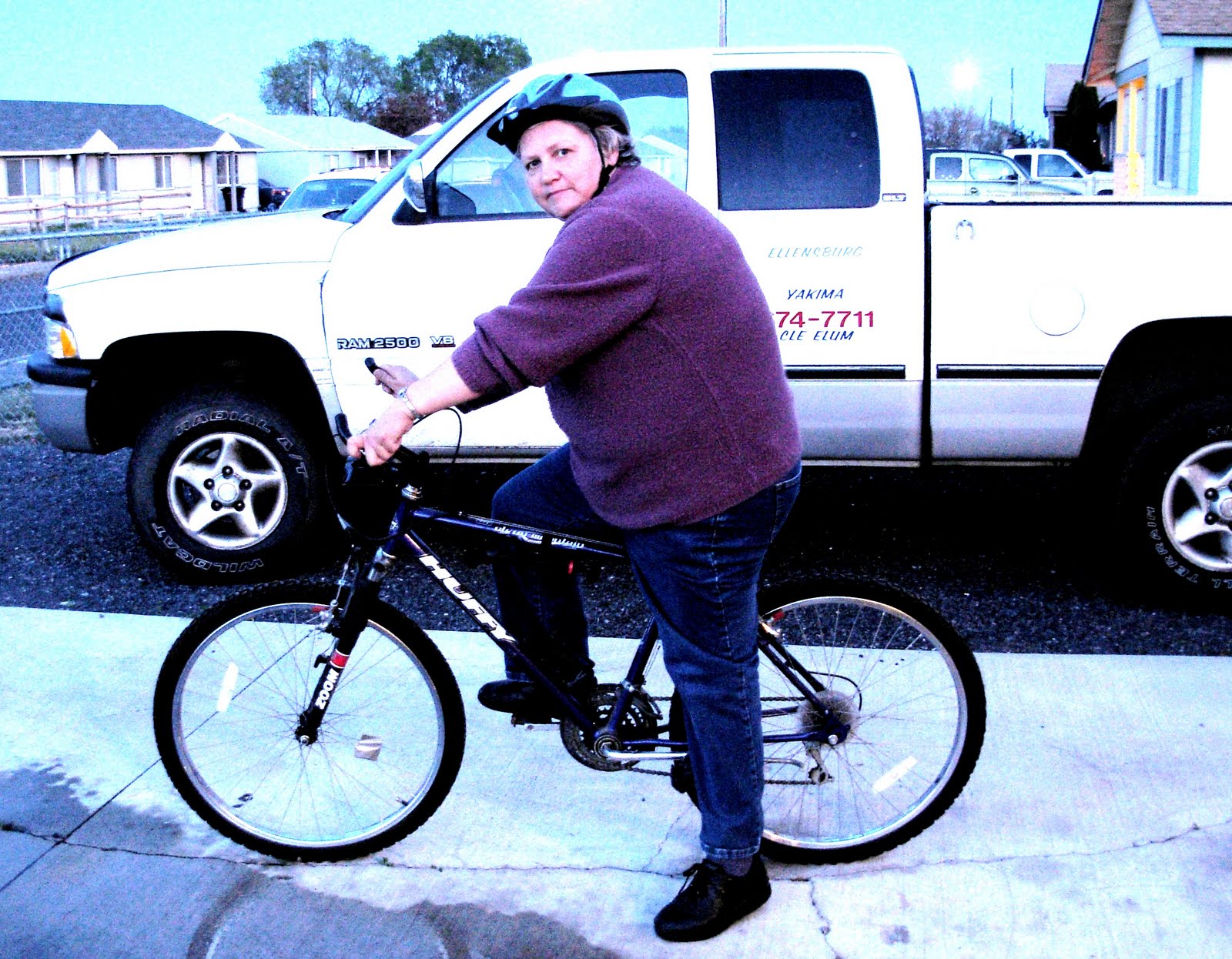
I got a bike for Christmas.  Papa gave me a miniature bicycle with working wheels, stunt pegs, pedals, and brakes.  Pretty cool little bike - the seat even is on a tension spring.  All the kids that come want to take it home.  I left it on the tree until we cleaned up Christmas.


Now it lives on the bookshelf at child's eyeball (and finger tip) height. I didn't know it could be taken apart like a real bike and that there are interchangeable parts (to buy of course). The kids tell me this as they hold up their hands full of pieces and tell me there is one (tiny) piece they can't seem to find!
But we do seem to always find it.

I never really believed I could ride a bike again -
walk, yes - run - maybe...
but ride a bike????

I have been working on increased mobility for about 2 or 3 years.
Papa keeps egging me on.


I pedal my small exercise bike.  The kids all love it too.  When Avy and Raanin are here for Christmas 08 it really gets a work out.


The grandkids can't seem to leave it in one piece either. There is a tension screw on top to adjust how hard it pedals. Funny thing - those pedals seem to always be put away when some kids visit lately.  Mom taught me that "what the eye can't see the heart can't grieve.' And they can't punch each other or cry about turns neither.

The left leg/ankle will do what ever the right leg makes the pedals do.

Last week Papa announced that he has the bikes ready.  Monday we bought 2 bike helmets at a local department store. That was Family Home Evening this week.

Wednesday was the big day.
I DID IT!
I rode a bike.

I got on it!
I almost fell down!
Papa lowered the seat.  Now I could touch the ground with my longest leg. (He showed me how to simply mount it by stepping on one pedal and swinging your other leg over as you get going - YEAH - RIIGGHHHTT!!!)

I rode it wobbling crookedly into the sprinkler and got soaking wet - but I did not crash!

I suggested Papa lower and level the front of the seat. Now I could get on AND off more readily and (if I tip the bike slightly) get either foot on the ground.


I rode it down the block and back to the driveway. (Yes I looked like a drunk driver - I assume with practice that will improve.)

I rode it all the way around the block with Papa, on his bike.


Then he put them away in the garage.  An hour later (as it gets dark) I realize a pivotal moment, in my life, has occurred.

He did not realize it would be so difficult (or time consuming) for me to get myself by the scruff of the neck and make myself get on that bike. I honestly wasn't sure I could.  What if ... ????

We decide to take pictures. They are not wonderful but they are taken on that same day! (His back hurts if he leans over too much or too long so, a while ago, he fixed his bike so that it has high, upright handle bars.)


 He has a lot of fun on the bikes.  And I do love my helmet - color that is - it is one of my favorite colors!  He says it matches my eyes.

Monday, May 10, 2010

ONCE I WAS A BABY


I am grateful to have "... been born of goodly parents," 1Nephi 1:1 
-
back row; Dad holding Tim, Mom holding baby Linda 
front row; Rex, Gene, Randy

-
My mother had 5 kids when the measles came to live at our house.  Look at those red cheeks!
-
My mother sings hymns - randomly - snatches here and there. She especially sings them in church - with or without a book - but anywhere, anytime she sings.  She says her mother took her to choir every Sunday.  She told me, this week, that Wilfred once played a prank on her.  He sat on the stairs, behind the kitchen wall, and taped her for a long time.  She would sing a line or two of a song, pause, and when she began again she would sing part of another song or sometimes whistle.  She says when he played it they had many a good laugh.  "I didn't even know I whistled," she says. "My mother was a whistler.  She really could whistle."
 -
-

You have heard quotes and sayings from my father. 


He tells me (when I ask), "I learned that from my mother." Interesting that her father was known for recitations.


The family wrote some of the sayings down once.  We counted over 1200 things!  We all could just start quoting his sayings that we had heard.

Families spent time together when ever possible - even extended families and gave each other support and friendship. Many of the Forsyth's came to see my new baby brother, Shane (1956), blessed. I am the toddler (almost 2) on my mother's right knee and he is on her left knee. 
-
 Shane's baby blessing fall 1956   Composite photo by Rex
-
The 3 pictures below were taken about 1957 in Cardston on the south hill in the front yard of my Forsyth Grandparent's home.
-
From back to front, left to right: Randy, Tim, Rex, Gene,
 Linda, Shane - early spring 1957
I think from looking at the this toddler's face that I must have had a bit of personality to spare. I would be not quite 3.


  I also suspect that in this last picture I am kicking Rex because he is getting in the picture too.
There are few pictures of us at these young ages.  There are many times that the pictures that remain are with the Horne family (dad's sister Ruth) as is the case with the horse and kids pictured here.  

 Notice how very blonde we all were - except Rex (who was very dark) and Shane (who was always brown).  We spent a lot of time outdoors in the sun and always got quite bleached out each summer.
-
back row: Randy, Mom holding Necia, Rex
front row: Tim (facing left), Shane, Linda, Gene


-
Every spring the boys were given a 'crew cut' - shaved bald. And it appears that I got a new baby sister in 1958 - I would be about 3 1/2
 -

In this Christmas 1958 picture, as a 4 year old, I have a tight hold on my house keeping tools -otherwise one of the boys might get them. That is the little red broom I so naughtily used to mark up the ceiling above my bed with.  The 4 youngest kids slept in a set of bunk beds just off the kitchen.  I was on the top bunk at one end with one of the others at the other end.