BOTTLED

  • “Sometimes the questions are complicated and the answers are simple. Dr. Suess

Tuesday, June 14, 2011

REST

"Doing nothing is the hardest work of all,
 because one can never stop to rest."

I enjoy work-
of all kinds.
I have endured forced rest.
There is, in that, a mental and spiritual work.
I think I prefer physical work.

Work is a capacity to do and learn.
Work is developing, growing, serving, becoming.
All work is important.

My parents taught us to work.
They also taught us about rest - 
idleness and laziness.  

"Can't is a sluggard to lazy to try."
"Idle hands are the devil's workshop."
"The only thing wrong with doing nothing is that you never know when you're finished."
"By the sweat of thy face shalt thou eat ..."
"The idle shall not eat the bread [of the worker]..."

I think I heard such cliched sayings from not only my parents and grandparents but also our neighbors and religious leaders too. I am grateful for their wisdom, instructions and examples.

One the over arching philosophies guiding my life is striving for balance - but I never feel it is quite achieved. Intense curiosity fuels tangents of fervor-ed action on changing, ever rearranged fronts and diversions.

I will never be a concert pianist because I am too busy learning about too many things to diligently apply the principles and acquire the skills practice might confer. I will also never be a softball champion, an Olympic swimmer or Slalom Skier or even a consistent 4.0 student.  Life distracts me.

I admire those that can focus their energies and desires to achieve greatness and acclaim - and I understand and sympathize with those that dabble in multiple disciplines.

(It can also be difficult to accept developed talents or successful achievements -searches out more learning, more action and practice possible, and principles I haven't attempted or applied yet.  I clearly see my fallibilities and understand the impossibility of ever completely learning or achieving all theoretical probabilities.)

 I, - ssssiiiiigggghh,
consider all I can't do,
and plod along attempting what I can -
AND trying to prioritize and organize my efforts
 to achieve and complete valid useful results.

Work can be grinding and discouraging.

I was also taught to rest.

I am grateful for the fun and the examples
those same adults were of rest - after diligent hard work.
Ice-cream.
Swimming.
Skating.
Fireside sing-a-longs.
Monopoly or Rook.
Quiet reading.
And the Sabbath ...

One day of each 7 to seek the perspective, refreshment, and renewed vigor needed to resume the ongoing struggles of mental, physical and spiritual self. These, work and rest, have no real division for me as each affects and effects all else.

Scripture records the example of God -
about work and rest -
and about the results of each.

"And on the seventh day I, God, ended my work ... and I rested on the seventh day from all my work, ... and I, God, saw that they were good; ..." Moses 3:2

 In the Bible and other revealed words from prophets we learn God works, he rests, and about what he accomplishes (it is good).

My work gives greater meaning and enjoyment to my rest.

God commands man to work.
None of us seem surprised by that.
We accept that necessity
and can choose to enjoy work.

He also commands us to rest -
and set an example of doing so.

So why do I ever try to do anything except that on Sundays?
If I accept the one commandment then why not the other?

Can I choose to rest?
Truly rest?
Seek His refuge, and his love,
his solace and comfort
and blessings?

Each commandment promises 'good' - blessings for obedience.
What are the blessings of rest?
Of keeping the Sabbath?

Saturday, June 11, 2011

WORK

clover in flower bed - honest - there are flowers in there! 

My yard is a disaster!! 3 years of neglect is a bit much. I had a surgery in July 2009 - there goes that year!! I had another surgery July 2010 - write off another year!

This year the problem is motivation - desire.
What is all this effort really accomplishing?

I see July 2011 coming and I haven't gotten completely around the yard yet. SO MUCH TO DO!!!! Today I tackled about 10 feet of the back flower bed.  I can only work for a short bit and haven't much stamina back.  Grass and Irises seem to have a major attraction to each other - the Irises grow towards the grass and the grass - well let's just say that if there is grass anywhere on the planet I am sure it will find a way to get into my Irises.

I had a pile of rocks once - quite unsightly!


Moses Lake should be called Moses Rock. Every time I touch a shovel I find a new boulder.  My kids think I am like a water dowser - but I use a shovel (instead of a forked stick) to find rocks. And I wonder if my garden grows more than vegetables.

Most  rocks pictured here came out of my garden and flower beds. I admit I found a basketball sized round white rock that followed me home one day but mostly ...

What do you do with so many rocks?
I get creative.  I, of course, means 'us' and 'we' and it was not a royal 'we' either - I had a lot of help and the process seems to be ongoing.  Every time I think I am rid of my stash more rocks seem to appear.

By moving one rock at a time I can make my rocks useful, functional and even decorative.
Notice the rock path along the front.

I pile them into walls.
The walls terrace our sloping lot.


I make edges with them.

property/flower bed edge -  rocks define edge

I lay them under the gravel when I need a driveway - first the fist sized, then the egg sized, then smaller stuff, and top it all off with a shallow layer of gravel. We only needed a couple of pickup loads of gravel.

My pile was the left overs from driveway construction - plus we dug out a new bit of garden about 8'x12'.

I began, I sorted, I gave up, I started again, I ignored naysayers, I sorted in new ways and places, I cleared and measured a small area and then started to place the rocks one at a time until patterns in my mind emerged into a walkway and fire pit that used many sizes and shapes of rocks.

that is a thin skin of gravel over a rock foundation on this driveway


I worked.

Sometimes a grandchild could be bribed to help and a few times my spouse hung about but mostly I just spent a small amount of time each day doing something to make it happen - anything - even standing looking at it and thinking!

Several times I decided I was foolish and it was of no use. That didn't get rid of the unsightly rock pile however. The pile was there a few seasons. And rocks are one thing but weeds and grass started to grow- how does grass get into the middle of the driveway anyway?

And then someone threw a brick on the pile,
and then a board and ...
I could see where that was going!
Not going to happen in my yard, I decided.

So I began to think and I started again.
I changed my mind several times.
But I hadn't actually done anything yet.

Then I started and changed my mind again.
I had wasted a lot of effort.
A couple months passed.

Then I made THE decision.  Since I couldn't get rid of the rocks any other way I could make them useful.  We had a small fire pit - just an old rusting wheel rim. The rock pile was against it on the driveway side. The grass area was badly worn and the heat when we burned things made it worse.  Only a bit of stubble sprouted for several feet out. I decided the rocks might as well lay there in an organized fashion.

I made a genuine commitment to myself -
and then I kept it. I worked every day -
even if it was cold, or wet,
even when I was tired,
even when I felt crummy,
even when I was sure I was silly,
especially when I felt I was wasting my time.

As I clean and weed the yard and edge the beds I feel like I did when I started and quit so many times on that rock pile.  Cleaning that 10' or so of flower bed was daunting today - it seemed impossible.  I think impossible might just be discouragement or despair in action - or rather lack of action. It took time. It took effort.  There are about 50 more feet to clean! It seems overwhelming and I have barely started!   My legs hurt, my back aches - wah, wah, wah - I experience that whether I work or not (so I might as well work), whether I complain or not (and that is not fun to hear - even from myself), and you can't believe how hard it is to just put on my shoes and find my gloves etc!

But 10' is clean and planted.

I cut myself some slack too - I come blog or look at Facebook, talk on the phone a while or take a nap,  have a snack or go shopping,  -  and then I get back to work!

Work is doing what may not seem fun or easy.  It may be misunderstood.  It may even be a time of learning - changing and especially decision making.  Work is doing something persistently and consistently - diligently and often repetitively. It feels good just to do it for the sake of doing something - choosing to act!

Our 5 year old granddaughter calls every so often.
 She always asks for her Papa.
He is usually 'at work'.

She asks why.  I tell her he gets the money to pay for food and for gas in our car so we can drive to see her.  She seems satisfied with that.  He works. Good things come from work.  That is OK for her.  It is OK for me too. Thanks Papa.  I like having a house.  I like good food.  I especially like to visit family.

In March while listening to a CES fireside I heard L. Tom Perry say,
"Prayer is a form of work ..."

His statement caught my mind with force
and completely engaged my attention.
Prayer is a form of work???
I don't remember ever hearing it put quite that way.

And then he continued ...
"and is an appointed means
for obtaining the highest of all blessings."

I was astounded.
I wrote it on my bathroom mirror.
(I will tell you about the mirror another day.)

Prayer - like moving rocks?
Prayer - like digging out weeds?
(Did you ever let clover go to seed in a flower bed?)
Prayer - like separating grass roots from Irises rhizomes?
Prayer - like vacuuming? or dishes? or laundry?
Prayer - like a job? like every day? for hours?

When his talk was available I listened again so that I could be sure I was quoting it correctly. I was astonished again and felt a tiny bit foolish when I found a footnote next to his statement that indicated it came from the Bible Dictionary [page 753] in the King James LDS Bible.  I wonder greatly that I have never understood this.  Surely I have read it - probably more than once.

Perhaps studying my scriptures is another bit of 'work'.

Hmmm ...

I'll 'work' on that -
along with a few other things
AND prayer!!

Tuesday, June 7, 2011

TITLES

I indexed an Old English record [1500's] this week for the Right Honorable Most Gracious Lord [SomebodyorOther].

His name was something else, other than that title. 

Indexing, for those that may not know, is an opportunity to help make all the vital records in the world searchable - to digitize and 'index' any and all available records so that anyone that wants or needs to can find their ancestors. Anyone can help do it. It costs no money - yes it is free, and you can 'test drive' it here and once you try it or sign up there is no minimum commitment or amount of time or quantity that is required - how much or if or when you do any records is up to you.

 And let me add/warn - it is way more fun than any video game and you get points for doing it too. It can become an obsession - it is addictive ...

On Monday this week almost 1 million records were ready to be made available to the public - 946,521 to be exact - almost 2 million were indexed the same day - that is a lot of names on a lot of records!

There - that's a blatant plug for indexing - now back to blogging!

Anyway - as I typed in the name I noticed that none of the lengthy title that may have made this man or his family important in the place they lived was needed to make his descendants able to locate him in an index.  I began to ponder and notice the designations that I was required to attach to his name and to the names of his family -

Father, 
husband, 
son,
wife, 
mother, 
daughter,
child -
born/baptized
buried
married (widow/er or divorced)
single (bachelor, spinster).

Very basic terms and states of being.

A friend sent me an e-mail asking that I fill in several lists of 3 things about myself to share with her.  I noticed she could fill in 3 actual names she has been called.  I began to try to think if I had ever had a nickname or been called anything except my given name.  After some thought I realized that the only names I have are my given name, mom and grandma (or some baby-lisping variant thereof).

I can not think of any more desirable name or title.

Father, mother.
Husband, wife.
Son, daughter.

Each of us have at least some of these titles.  

They are precious and everlasting titles. 

Friday, June 3, 2011

ONCE OR TWICE

The house next door on the north is a rental. As tenants move in and out usually the grass gets watered - at least once (and some times twice) per year and in the spring gets mowed - at least once.

On the south, our neighbor has a beautifully manicured green lawn. Well - had. She moved in about 15 years ago and her lawn was always beautiful and well kept.  I asked her what her secret is. She said it is to mow the grass once a week whether it seems to need it or not - and to use a specific fertilizer once a year.

We started following her example (sans fertilizer that costs money) and our lawn improved immensely. But sometimes we only mowed every 10 days.  We eventually tried the fertilizer and discovered that it
a. turns the lawn deep green,
b. makes it need a lot more water,
c. requires more mowing and
d. needs extra care in other ways (we think the weeds do better too and we never had clover before using that brand of fertilizer and couldn't seem to get rid of it until we stopped using that).

Mowing once a week seems to be the secret to a decent lawn - and giving some water.

About 2 years ago South Neighbor started a new job and now only mows and waters on irregular schedules. Her lawn looks a lot like ours now - not bad but not always as terrific as previously.

North Neighbors sometimes complain about the terrible condition of their yard. They also complain that their landlord won't listen to them and reseed the back yard (that is dormant and weed infested).  They further bash the landlord for giving them notice to water because that costs more money and causes them to have to mow more often and they already got a notice from the landlord this year that if the lawn is not mowed by a set day that the landlord will have it mowed and charge the cost to them. "It is so much trouble to live here," they explain, "it is so much work and no matter what we do it never improves the yard or makes any difference."

Really? Did they really think that leaving a tiny sprinkler running all day and night for 3 days (so that a giant puddle formed in a low spot and eventually ran off like a river to the street) would make the lawn grow better and magically be a groomed, manicured yard? They did not move the sprinkler or turn it on except on the day they got a notice to do so or pay. Did they really believe their yard would look like paradise by mowing only after the grass was taller than their knees and left 'hayfield stubble' that became dormant from that lack of water? And why wait until the county notifies you to remove the noxious weeds or pay a fine and the cost of having them sprayed and removed?

I began to notice a pattern - for both neighbors.

 On the north it was "only do what is required and that compulsory means mandate.  And only make the minimum effort specified - or perhaps a little less if it can be gotten away with."  They ask how we get our grass to grow but they don't want to do any of the things we try.  They are happy to let David spray their weeds when he sprays ours! The few extra pennies of prevention is worth many pounds of cure on our downwind side of the fence.

On the south it was "make time and effort to do all the can be done - even before required - and take personal interest and responsibility for life and surroundings. And always do something - just try."  Even the dark green and yellow stripes of improper fertilizing were just a learning experience not an excuse to quit trying - just a new chance to learn and become better.

My parents taught me you only need to pull a weed once if you get it before it seeds.  There may be many weeds but each one only needs to be removed once if you prevent seeds and roots from being established. My father was particularly vigilant about thistles and burdock.  Mother hated thistles too but was quick and poison death to morning glory and anything else with invasive roots.  They instructed us carefully about getting the 'root'.  Ragweed, red root and mallow just had to be hoed or pulled. Even a kid breaking off the top was preferred to letting them go to seed.  And what kid wants to step on a thistle with bare feet?

I notice habits can be a bit the same.

Some of mine are somewhat like the barefoot kid
trying to avoid thistles.

I try to 'walk' my entire garden and yard once a day and no less than twice a week.  When I do, I see problems when they are small and more readily resolved. I can pull out the weed hiding among the daisies or dahlias or see the seedlings sprouting from bird droppings.  I notice when it is time to spread Preen on the stone path or gravel driveway as just a few sprouts show themselves and can be hoed out quickly. I see a diseased leaf or twig or a new bug infestation.

My yard and garden are a good analogy of life. Some weeds come no matter what I do and I have to pull them out before they can become established or cause other problems. Some good habits prevent the growth of other less desirable habits that, like weeds, seem to always show up and choke out the grass or vegetables or flowers.  And sometimes even good things can (like calendulas or columbines) become invasive themselves in such overabundance that they are like bad habits or weeds with negative impacts and consequences.

Calendula is a drought tolerant edible flower/herb that can grow in almost any location and has many good uses. It's pretty daisy shaped blossoms (in yellows, oranges, and reds) make prolific seeds several times a season that will grow even in sidewalk cracks. When it bushes out nearby plants stop growing or die back (nice for weed prevention) and a better balance must be regained. Calendulas grow easily and can be removed easily.  Just break a plant off or hoe it out and it is gone. No invasive root or tough unbreakable stock and the seeds stay dormant if not watered and seeds or small plants are easily moved to new locations.  I love them on all counts.

I struggle for balance in all areas of my life. I try to learn new things each day (like what is that and why is it growing there?) and try again to apply some advice or counsel that may change something for the better (wow - why didn't I get a quiet, battery operated, electric lawnmower years ago?)- and I 'walk' the property.  I enjoy the sights and scents and pick a few vegetables or herbs, water something a little, and ALWAYS watch for the weeds - and stop to pull one ...

at least once or twice.

Monday, May 23, 2011

MOTHER

May is a month when we traditionally take a day to remember the importance of mothers.  My career of choice has been wife and mother. Some women desire and choose motherhood - others find being a mother a sudden surprise they are unsure of welcoming. Mine loved and wanted children.

My mother with 4 sons and (finally) a daughter
My mother is an excellent support and example.

I have often not appreciated or even liked her -
especially when I was growing up -
I had a rather large 'mote' in my eye.
I now apologize to her for those years.
I have learned to respect and honor her.

She inspires me.

One day, many years ago,
I realized how amazing and choice she is.

My feelings at such times cluster into groups of words that some might call poetry (but I know little of meter or rhyme).

At that time I tried to express the positive influence she had in my life and the lives of all around her.  I began to write:

My mother was a diplomat -
Oh not in silly ways
With kings of countries
Or queens of nations
Uttering her praise,
The kings and queens
My mom knew best
Were me and Sister Sue*
She never told us no
If a type of yes would do.
Yes, you may clean your bedroom,
Yes, you may come in from play,
And yes you're coming with me
Although you'd like to stay.
If no could be the answer
Then just as sure as you please
She'd turn around the sentence
And put you in a squeeze.
She'd reel off all the yes's
And much to our chagrin
Some where before she'd finish
All the outs became quite thin.
She never let us dangle
Or stay long in a spat,
We came along quite nicely
With 'just a bit of chat'.

* Sister Sue was a nickname any of us might be called.

Expecting 10th Child
My mother speaks 'encouraging words' that lift and sustain long after they are spoken.  When I talk with her, at times, I discover firmly held opinions of 'black' may change suddenly to 'white' as understanding and direction come like dawn breaking over the horizon. And other times I discover some opinion or thought validated to a meaningful form that becomes a solid foundation for action, belief and sustaining faith.

Mother seldom voices disapproval and almost never criticism. She often tells me ways I am succeeding - even in the smallest of ways - she sees and notes every increment of good.  I want to be the competent and genuinely nice person she believes I am and can be.  I want to please her and validate her kind and lovingly gentle (yet firm - there is nothing wishy washy about her and never has been) words.

I honor her strength and her power to influence -
to give not take, and to build and lift
not tear down.

She is 'just' a mother.

Sunday, May 15, 2011

ESSAY: Issues of Technology

In 2001 I took a test to prove I can read and write English in a coherent literate way to allow me to work in the schools or take college level classes.  The test consisted of a few questions regarding grammar, some questions regarding several written passages I was required to read (on a computer), and writing an essay (from a selection of random topics) of at least one page in less than 90 minutes that would ideally have 5 or 6 paragraphs.  I asked and was given permission to write it on paper. I was required to write it and submit it as written without making a rough draft or outline prior to composing it.  I scored as high as was possible to score on the test.

The testing center mailed a copy of the essay to me and suggested I keep it for my personal records.  I found that copy this past week. The topic I picked was Issues of Technology: A Changing World. An interesting aside is that the lab technician had to show me how to use the computer in the testing center.  I was not familiar with Word. We used Corel Word Perfect at home (a much nicer program I must state) and I avoided computer use altogether if possible.

Only 10 years have passed. For 5 of those years I worked as a tutor for students age 12 - 18 in English, Math and Business.  The teacher in the Business lab liked how I worked with a student that was a Senior (in her English class) and requested me for her business classes.  I became proficient in computer use as I heard her courses for several years and assisted teenagers to understand and do what the teacher expected.

The following year I began supervising other tutors and programs full-time.  Part of my job included publishing a monthly newsletter on the web for the Grant program funding my position and as a piece of mail for parents. I was also expected to prepare organized, on line photo albums with appropriate titles and captions and administer several aspects of the program using the computer programs (and several more applications) I had learned from those business classes. Basically I used the computer and the Internet a lot.

In 10 years my world completely changed! In my essay I explained how my granny's world had changed.  She lived 105 years. I did not know her real age when I wrote about 1967, and felt at ease taking license with data to make it fit my topic. Remember this was written without a computer or any chance to edit or rework the order of sentences or paragraphs.
The essay follows:

1967
One hundred years old - both my country and my great grandmother, who lived with our family.

Mary Bohne, born in England, crossed Canada the first time from east to west in a horse drawn buggy. I sat enthralled at her knee as she compared that first adventure with the wonder of jet airplane travel she experienced on her 100th birthday traveling west to east.  "Three hours not three months," I remember her exclaiming again and again.  "Three hours." What a marvelous change Canada had undergone between 1867 and 1967. Technology of many kinds had altered quality of life and manner of living dramatically and drastically.

Jet travel was not the only change my young mind accepted as normal. Although many remnants of the past clung like cobwebs to the corners our parents occupied in what was familiar to the new generation, little remained except stories and museum relegated icons for the 2nd generation following. I still knew, understood, and accepted as part of normalcy horses, telegraphs, outhouses and a much slower lifestyle of family cohesiveness largely uninterrupted by radio, TV, multiple automobiles, telephones and the ever expanding world modern telecommunications presents and unifies and/or divides. I remember when our family got hot and cold running water indoors, electricity, and our first radio. My parents marveled a very few years later when that radio was changed to a transistorized, battery operated, go anywhere set.  Life was indeed simple. Affording luxuries like a telephone, various electric appliances, and a car not exclusively for transport to work rapidly affected that very simplicity. The speed of the auto and the additional time freed by instant voice communication, and labor and time saving appliances such a refrigerators, electric stoves, and washers and dryers (along with a multitude of other helpful devices), allowed for time to do more things with the consequence of less overall time and more pressure to accomplish more things. Nonetheless we always somewhat feared and wondered at all the gadgets, buttons, planes, motors and wires.

Technology has also changed expectations and even the ability to accomplish many tasks as, for example, mechanical and other assistive devices permit smaller and weaker personnel to complete jobs previously only the strongest or tallest or fastest could perform. My children welcome a host of new devices; computers, color televisions, VCRs, compact discs, space shuttles and stations, and other technology I can only guess at.  Buttons and wires have no fear or wonder for them. When I have a question I ask my children for help. They often can answer or with their knowledge and my experience we can figure it out. Experience and wisdom of a  previous generation may often apply in surprising ways. At my parents insistence I learned to type - badly! I hated it. I was lousy at it.  It was, however, a skill a girl could utilize in a male dominated work world.  Now, typing is vital for computer use. Weekly I spend many hours coaxing my parents generation to try button pushing - to mimic us, their children and grandchildren. We need them.

My grandchildren are afraid of horses.  They see them so seldom and at such distances that a horse is a large and frightening animal. My grandmother could harness 8 Perchons to a double bladed plow at age 8. Each generation learns routines and familiar patterns. Amidst change there remain some constants. New technology currently is changing the buttons and wires: radio waves, fiber optics, lasers, genetics - the list can lengthen endlessly. We begin to speak to our machines and guide them by voice. We scan and transmit documents and digitize and create in the very air, and war in space.  I am in awe.  What has changed? My visiting grandchildren sit at my knee and think I am a bit funny - enthralled.


Friday, May 13, 2011

IMAGINE

Imagine you own/have nothing.

No land.

No machines.

No house, no car/truck ...

No appliances or furniture ...

No pictures or books/magazines ...

No clocks, cameras, phones or gadgets.

No video or audio equipment, no computers or peripherals.

No clothes/shoes - if you are wearing something it is borrowed.

No cloth or clay, metal or wood, glass or plastic things -
or soap, and other manufactured or simple resources.

No dishes, pots/pans, utensils, tools ...

No toys, no games ...

No blankets ...

No food ...

(You can't have a job,
or any money either.)

Imagine.

What is left?

The resources of the earth?

What do I need?

How about water,
the warmth of the sun
or even dirt?

What am I taking for granted?
(Plumbing - I know I take plumbing for granted!)

God.
Family.
Friends,
knowledge - skills,
health (or lack thereof).

 And time - always time ...

Perhaps the thing I need most is gratitude.
Especially gratitude for the short list of important things I never seem to think about, that I always expect to have and often neglect. Perhaps I need to put such things that I take for granted, at the top of the priority list that occupies my thoughts.

Perhaps I need to scrutinize what things are first.

I just looked around myself.
All the things I see mean nothing without you.

Hmmmm  - * think, think, thinking * -
what have I said/done lately so that you know?

For example: does my spouse know he is more important than the frig? do my children know they are more important than my car? do my friends know I appreciate their companionship more than television, sport or movie stars? do I value my health more than chocolate?

And have I learned anything new today?

And finally and yet always first and most important and precious - God. What place do I give the great eternal being that created and blesses my existence?

Am I grateful I can breathe,
and think, and feel?

What thanks can I give to you?
or to anyone?
for anything?

Monday, May 9, 2011

KNITTING UP

Twist yarn (or string) in a loop around pointy plastic or wooden sticks about 14 inches long.   Do the same repetitive movements until you a lot of loops around the stick.  Now turn it over and using another similar pointy stick (sorry no hook on the end - just a slippery point) transfer each loop off the 1st stick and onto the second one by pulling the yarn through each first loop to make another loop.

Leave the new loops on the second stick and since they are through the first original loops let the first stick slide out of each first original loop as each new loop stays on the second stick. The first original loops will hang below each new loop.

 google image
The original loops make one row, the new loops make a second row and each time you turn it over and make loops again another time you get another row.  Eventually you get lots of loops and rows (hundreds and thousands of them) and they look nice and neat and make a stretchy fabric - IN THEORY!

In fact, the loops must never be twisted (unless you do them all the same or in a pattern on purpose) and if they 'accidentally' slide off a stick a nasty hole ruins not only the row you are working on but all the rows below it.

In a perfect world it can be 'fixed' by sliding it back on the stick at the right place. In an even more perfect world the loop can be looped back into the rows below it all the way to the top and no one ever knows of the accident. 

In my world I don't see the missing loop until many rows later.  
In my world all the rows have to be un-looped
and looped over again - sometimes hundreds of them.

And in my world the loops never look the same again.  

I have persisted at this challenging activity for most of my life, learned many things, managed to make a few baby blankets and fixed some clothing, and STILL find it at times, very difficult. 

Knitting is not one of my strong talents.

I first learned to tangle yarn into a semblance of a slipper when I was about 10 years old. All the girls at church had to learn - to make at least one knitted thing.  It was VERY difficult for me. 'Simple' slippers (that to me looked ridiculous) were the suggested project for a beginner.

 My mother does not knit. My father knew how but he was often not home from work when I was awake (and not doing chores - chores came first). He reassured me that, with persistence and patience, I could learn to do it. His mother could knit beautifully and made exquisite patterned, wool sweaters. His had a border of deer encircling the lower edge. Of course she passed away when I was only 6.

I learned the terminology too.  The pointy sticks are called needles and have gauges or sizes. The yarn has sizes (gauge) and plys - how many threads twisted together to make it and what weight those threads are. The loops are called stitches and stitches have names. The names even have meanings. 

I learned to sew and embroider as a child. As an adult I taught myself to crotchet but knitting just did not make sense.  I just couldn't understand the difference between a knit stitch and a purl stitch.

A slipper I made for Christmas the year I started knitting again -
I really didn't care if there were rows (like the needle points at)
where a stitch or two is knit instead of purl -
at least not enough to rip it out and redo it. 

I was about 30 and trying to remember and relearn how to make slippers when I met Aunt Bunny. We were on our way to a family reunion and would be in the car together for about 18 hours. She had knitting. She said it is easy.  And it IS!!!

Knitting is just a bunch of loops that you could make with your fingers if you wanted to but needles let you hold them all a bit more conveniently. And a knit stitch and a purl stitch are exactly the same thing but when you look at the 'front' it makes a 'v' that is called a knit stitch and when you look at the other side or 'back' where you can only see the very top of the stitch (as it loops around the next one that is pulled through it) then it is called a purl stitch.

google image
WHAT? . . . Did
someone ever tell me this?
or try to?

I don't think so - they only said that there ARE knit and purl stitches.

Nancy the skilled knitter of lovely lace may have tried.

It just wasn't my time to try again -
but I must credit her for making knitting sound possible -
and I filed it into my brain's "someday" category.

She reassured me that if I had made those slippers I KNEW how, and like riding a bicycle, could do it again.

Aunt Bunny also showed me that knitted fabrics have names.  
The names just are labels for groups of stitches. The stitches and rows can be cleverly stretched or compressed, have extra loops or be looped together (be added to or taken away from), twisted or turned in marvelous patterns to make lace, utilitarian objects, and even art. I think she had a book with pictures too - possibilities. I even learned to knit in the round and made some finger puppets. 

Aunt Bunny, bless you - or curse you -
depending on how my knitting is going ... 

And Elizabeth Campagnola - she gave me a 'real' pattern and taught me to read it. She also asked me why I twist my stitches - I asked her to show me what she meant.  She did - I couldn't tell the difference.  Last year I learned to knit Continental style. It is faster and lo and behold - my stitches are not twisted! I can see the difference this year. I wish I had her book - I would try some of the other pretty stitches and things in it. Sadly she passed away many years ago.

The pattern she gave me is for the baby blanket I still make. A simple but pretty fan stitch - why make slippers if you can make lace? I hate slippers - they are useless, and I hate knitted slippers even more - they are just plain ugly! and after all that work they wear out in the snap of your fingers - if anyone bothers to wear them at all. 

Baby blanket auctioned at the 2007 Forsyth Reunion.  

Knitting makes me feel foolish, 
completely clumsy, 
and totally incompetent.
Hopelessly so.  

It almost seems like a metaphor of my life. 
I mostly feel that way about everything. 

BUT knitting is a good metaphor.

I can always start over.  
A fresh start is a wonderful opportunity to do things correctly.
All the yarn can be un-looped, pulled out and wound into neat, tidy balls again - true its nature may be changed a bit and it may have stretched places and snags or breaks but it can be repaired and it is still useful. I may use the worst pieces as string for such things as to mark garden rows but it still has purpose. 

I too have purpose - even on my worst days. 

I can choose what I am making -
possibilities are almost endless - 
and I can modify my choices as I knit.

I can even change my mind when I start over, 
or when I learn something new. 

The sooner I fix a mistake the less noticeable it is 
AND the less time consuming - 
AND frustrating -
AND damaging. 

The more diligent I am in counting, and counting, and counting, and counting, and counting, and counting, and counting,
[in life counting my blessings] the sooner I notice my mistakes.  I need to count every row and on larger projects use stitch markers to count every 10-20 stitches.  Diligence means ALWAYS doing the simple basics, like counting and moving (or placing) stitch markers - ALWAYS, every single time.  An old saying (quoted by Ezra Taft Benson) states that "it is easier to prepare and prevent than to repair and repent" . 

I can give up if I want to - 
but I never do - I just take 'rests' - 
and then I finish the project 
EVEN when I don't really feel like it. 

There is something very satisfying about sticking to something and seeing it all the way through, enduring and persisting through discouragement in spite of hopeless incompetency. And surely my patience and love are refined as I let others endure and encourage them to try.  It is so nice when someone encourages me to keep on keeping on in spite of myself. 

I can get help.
There is always someone willing to teach me a new trick, give me advice (and yarn), loan me patterns, give me advice, tell me where expensive things can be purchased, and did I mention  - 
give me advice? My advice now is to do a search on the web - you can find tutorials, patterns, instructions, tips, tricks and gadgets - lots of gadgets - and then forget about it all and find a real living breathing person that knows you can learn and may even like you (or at least you may like them or something about them).

I can be mocked. 
My knitting is not perfect.
Knitting takes me huge amounts of time. Most other knitters can spot my errors - or wonder if that is really knitting. That stretches my soul like an overworked piece of yarn until sometimes the fraying worn spot breaks. When it is mended back together there is a bit of a thicker spot there where the yarns are spliced.

It is something I CAN do.
We all can do something.
And it doesn't have to be perfect - 
or even as good as yours - 
and your something doesn't have to be like mine.

Thank you Aunt Bunny -
I have a hobby I love to hate ...
or is that 'hate to love'! 


Thursday, April 28, 2011

RUTS and parents marriage

-
Garth and Jean Forsyth on honeymoon in 1948.  Mom says they went shopping
 in Great Falls and this is the blue shirt and pants he bought her as a gift.
 Car owned and loaned for honeymoon by older brother Ken.

My father and mother met and were married about 1948 while working on a ranch in Southern Alberta.  She came to the Ranch as help for the house when she finished 10th grade in June. On her 18th birthday in September they got the day off, caught a ride to Cardston where they could take a train to Lethbridge and they bought a diamond ring. The train home went through Hillspring (it had a daily loop it traveled) so they stopped there for him to meet her parents for the first time and tell them the news.

My father tells me that he 'jingled' or brought in the horses for the other men in the bunkhouse.  He did it because he was an early riser and had to get his own horse so figured he might as well get their horses while he was at it.  The boss noticed and at the end of the pay period added a quarter - yes 25 cents - to the 3 dollars (plus room and board) that he was being paid for each day - do the math ... 3.25 X 30 is about $97.50 per month. They worked every single day including Sunday. 


His habit of getting up early and giving unasked, willing service to those around him put extra money in his pocket, gave good will among his associates, and self esteem in his soul.  He says the praise and appreciation from the boss meant more to him than the money that he "blew just like all the rest of it".

Jean Campbell Forsyth centre back

My mother earned $50.00 per month to tend children, help keep things clean, cook for the men in the bunkhouse as well as the family and any other general house and yard/harvest chores required.  She lived with the family as part of the family and was expected to do what ever needed to be done.  


When they married they moved into a small house at the 'Horseshoe Bend' on the St. Mary's River and earned $80.00 per month (house included without charge).  Dad says that during harvest season the men earned $5.00 per day. Motorized vehicles were still uncommon but the ranch did use a small tractor for plowing, seeding etc.  Horses were still the main method of travel. Horses were also used for much of the work on the ranch.

Little house at Horseshoe Bend 

To get to their home they drove across the prairie to it, over hill and dale,  whether in a car or a horse drawn wagon.  They tell me that 1948 was a rainy year. Dad says he got about 60 acres seeded before the rains started and then it was too wet to do more. 

As wheels and feet traverse the same place again and again a path is worn into the land as the sod is packed hard and the grass and other vegetation cease to grow.  These 'roads' generally went the shortest (or easiest) way between any given destinations.  

These dirt 'roads' became almost cement like when heavily used but grass etc still grew in the center areas that were not as packed between the wheel tracks. When it rained the tracks quickly softened and became a deep mire of mud. Ruts formed might be several inches or (even much more) deep.  In rocky places the ruts would not be too bad but in some areas the road would become impassable. That didn't worry them too much, they just stayed home or rode horses. 

Mom tells a story about their first car quitting and from then on they would just hitch the horses to it to get where they were going.  It was warmer and more comfortable than any buggy or wagon and the rubber tires rolled easily and made the ride not so bumpy.  She says they didn't do that often but that when people couldn't afford gasoline or the car wouldn't work that hitching the car to a team of horses was an option. 

They tell a wonderful tale about getting the car stuck one winter on the steep hill going down to their house. They walked home and left it there until spring.  It was too much work and effort to move it and they usually couldn't use it in the deep snow anyway. When they did pull it out finally (one nice day) the debate was whether to take it down to the house or up to the top of the hill.  They took it to the top - there was less snow going up because winds scour the hills free of snow and drop it into the valleys below.


When I was a child my parent's visited the 'old place' many times. We picked berries and gathered rhubarb etc or swam and played in the river.  They have many wonderful memories of their early married years there. The ruts were so deep that once the car started on the road it could be very difficult to get out of them or change direction. Many times dad drove along beside the road (but then you had to be very careful because a rock could scrape and damage the 'oil pan' and ruin your car). 

My dad had a steady hand and also sometimes drove with the left wheel on the hump in the centre and the right wheel on edge of the road to the right, just up and out of the rut. This only caused problems if he had to get that left wheel across the right rut for some reason (perhaps another car coming along in the rut. There were flatter areas (likely rock underneath) where the ruts were not worn quite as deeply and that is where you could get out of the rut or turn around or cross them.  Yes, it was almost impossible to cross them, and you did have to follow along until one of those more shallow or flatter places to 'get to the other side'.  

There were also areas that were 'problem' areas with deep holes, dangerous rocks sticking up, or other hazards caused by those struggling with the misfortune of becoming stuck! - and you literally could get stuck in such a way that you absolutely could not move the vehicle. I watched (and rode through) many a miracle - I think my dad could take a truck or car almost anywhere with or without a road! He also has a very creative mind and relies heavily on inspiration to warn him to 'not go there' or give him the idea of how to solve what seems to be insoluble.

 A son traveled to Ohio and back by car last year.  He met his share of road hazards and needed to be rescued in Montana. A very kind church leader, that lived in the wild foothills along an unimproved road, took him home for a couple of days. He saw a deeply rutted road and heard a story about the man that lived up at the end of the road. Apparently the man likes to drink a bit much, now and again, and it is a worry to get home in the dark.  When he is drunk he is always relieved to get to the dirt road because he knows that now he is safe - the ruts will 'take him home' even if he goes to sleep or passes out.

That funny story seems pretty far fetched but it has me thinking ...

Do I have ruts / habits in my life that make it hard to get where I want to be? Do 'ruts' prevent me from changing the direction I am traveling? Do I have 'safe' ruts that allow me to continue to do what I often do and know I should stop doing? 

Yep! sure do!! 
Now how am I gonna get out of them?
And stay out of them?

How about you?

Sunday, April 24, 2011

SUNDAY

Easter Sunday -
a day I feel a at a loss to describe.

How can I express the sacred quiet elation -
the assurance and certainty?

I can't.

BUT
I can sing!
I do it privately - and in church!
Always in church.

Hymn 86 How Great Thou Art (with all its rich history) is not a traditional Easter hymn but it is a favorite I find I hum every time I see a wide expanse of sky, stand on a high precipice looking out and down (or deep in a valley looking up and out), watch water ripple along as a small stream or a raging river and at various other stormy and calm moments of life. Kimber blogged this hymn recently here. I had no idea ...

Verses repeat silently in my every fiber this Sunday:

"And when I think that God, His Son not sparing,
Sent Him to die, I scarce can take it in;
That on the cross, my burden gladly bearing,
He bled and died to take away my sin:

Then sings my soul, my Saviour God, to Thee;
How great Thou art, how great Thou art!

And I burst into outright voice:

Christ the Lord is Risen Today,  Al-le-lu-ia!
Sons of men and angels say, Al-le-lu-ia!
Raise your joys and triumphs high, Al-le-lu-ia!
Sing, ye heav'ns , and earth reply,
Aahaahaahal-laaayyyeh-luuuhuooy-ia!!!


Love's redeeming work is done,  Al-le-lu-ia!
Fought the fight, the vict'ry won, Al-le-lu-ia!
Jesus' agony is o'er, Al-le-lu-ia!
Darkness veils the earth no more, 
Aahaahaahal-laaayyyeh-luuuhuooy-ia!!!

Lives again our glorious king,  Al-le-lu-ia!
Where, O death, is now thy sting? Al-le-lu-ia!
Once he died our souls to save, Al-le-lu-ia!
where thy victory, O grave? 
Aahaahaahal-laaayyyeh-luuuhuooy-ia!!!

Notice those lovely rhectorical where questions?

I love that song - 
just don't sit in front of me 
in Church!!

A soloist I am not.


Friday, April 22, 2011

GOOD FRIDAY

Today is Friday.
Today is Good Friday.
What does that even mean?

I can only answer that for myself.
We must each find such meanings in our private ponderings.

I find expression of some answers in words spoken in Oct 2006 by Joseph B. Writhlin, Apostle of Jesus Christ, and member of the Twelve Apostles in The Church of Jesus Christ of Latter Day Saints.

"I think of how dark that Friday was when Christ was lifted up on the cross. On that terrible Friday the earth shook and grew dark ... evil men who sought his life rejoiced ... the veil of the temple was rent in twain ...

"On that Friday the Apostles were devastated. Jesus, their Savior - the man who had walked on water and raised the dead - was Himself ... [seemed] overcome by His enemies.

On that Friday the Savior of mankind was humiliated and bruised, abused and reviled. It was a Friday filled with devastating, consuming sorrow that gnawed at the souls of those who loved and honored the Son of God  ... of all the days since the beginning of this world's history, that Friday was the darkest."

I have dark days in my life.

Days that seem like all light and hope is extinguished. Days and/or nights that seem to have no end.

Times of utter despair.

I suspect you do also.

I hope not but also know it is part of living and dying, loving, serving and striving.


With the rain,

 sometimes,

 we may ...

if we wipe our eyes
and lift them to look -

glimpse a rainbow.

Elder Writhlin continues, "Each of us will have our own Fridays - those days when the universe itself seems shattered and the shards of our world lie littered about us in pieces. We all will experience those broken times when it seems we can never be put together again. We will all have our Fridays.

But I testify to you in the name of the One who conquered death - Sunday will come. In the darkness of our sorrow, Sunday will come.

No matter our desperation, no matter our grief, in this life or the next, Sunday will come."[emphasis mine]

I join my voice to his.

SUNDAY WILL COME.

And every Sunday I will look again at the white cloth covering the sacrament table and remember the corpse of the Savior and then eat and drink the symbols of His triumph! His triumph that dispels my darkness. Dispels all darkness of all such 'Fridays'.

And with Elder Writhlin I will rejoice and " ... live in thanksgiving for the priceless gifts that come to us as [children] of a loving Heavenly Father and for the promise of that bright day when [I] shall rise triumphant from the grave. No matter how dark [my] Friday, Sunday will come.

The Resurrection transformed the lives of those who witnessed it. Should it not transform ours? We will all rise from the grave. On that day we will know the love of our Heavenly Father and will rejoice that the Messiah overcame all that we could live forever."

For now I listen to the advice of Isaiah in chapter 24 (verse 14) and sing in the darkness, "Glory to God on high ... tell what his arm has done, what spoils from death he won ..Praising His name ..." hymn 67

Spring brings the changing season -
the daffodils - the birds - the green - the light ...
and Sunday will come -
even should Spring fail -
even in the dark!


Thursday, April 21, 2011

WHY and WHO

Two days ago my husband went to Horizon Credit Union to cash a cheque.  The teller mistakenly put it in my personal account instead of cashing it.

My husband does NOT have his name or signature on that account. He asked for the money. She then withdrew the money using his signature.  I believe he could have withdrawn any amount he requested at that moment.

Beware - Horizon makes 'little' mistakes like that. When they 'mistakenly' gave him a year's printout history of my account I notified them in person, and in writing and requested that this private account be kept private.  I also stopped using that account except for our car loan that is attached to it.  Yes his name is on the car loan. Horizon assured me that does not affect the account and that he does not have access to it.

I have nothing to hide from my husband or anyone else.  My finances have always been transparent in our marriage but I have also learned that my spouse and I do not think alike or manage money in quite the same manner.

Whether we like it or not the frustrating vestiges of a system that allowed some (often white men) to discriminate against others is still part of the very psyche of much of our world. We now often hear and see discrimination against those that dominated that archaic system. Their error is used as an excuse to perpetuate the same kind of mistake in reverse!

Good people never truly exploit other people although some good people did not or have not learned to value others. I will leave that exposition for another post - if  I ever feel so inclined.

Discrimination will only be rooted out when each of us makes conscious choices to value and respect every person regardless or race, gender, age, health, religion, political affiliation or any other factor.

That statement could be a dissertation!
A lengthy one.
I will leave it as is - a shortened deliberate statement.

Meanwhile I will begin in my own heart and mind.

Who do I fail to respect?

Do I hate them because they have more __________ or less?
I could make a list for the blank in the sentence above that might include stars and dots, power, money, talent, friends, religion, happiness, grammar, property, opinions, knowledge, - you get the idea!

I could also expound on any one or all of the possible entries and choices for the blank and justify, excuse or explain pros or cons.

OR I can start now to respect others more.

I can look inward and act more kindly outwardly.

I can treat myself with respect ...
and I can pass that respect on -
first to my own family -
my spouse, parents, siblings, children etc.

I will spare you another blank -
you know who your family consists of.

I commit to start today!

Monday, April 18, 2011

THREE LIKE SONS

I have 3 sons.

I also have 3 daughters.
They have each married a young man that is 'like a son' to me.

Each of 'these' sons has a birthday in the spring when the days warm, begin to lengthen, and the light steadily increases.
Easter, with all its symbolism of life and light, is close also. 

All my sons bring light to our family, and humour, and increase the vitality and lengthen joy in warm interpersonal interactions. Each of them leads my 'daughters' and their children towards light. I have been in their homes and heard them pray together and seen them play together. I pray for them each to always have strength and inspiration to continue to do so. 

Happy Birthday may seem like such a trite saying and (yes this is the third time I am saying it within a few weeks to these young men) yet I hope for their happiness, not only on the day the calendar marks, for them, the passing of another year - their birth day, but all other days too. May God grant them strength and the humility that will bring them the patience any husband and father needs.

Sunday, April 17, 2011

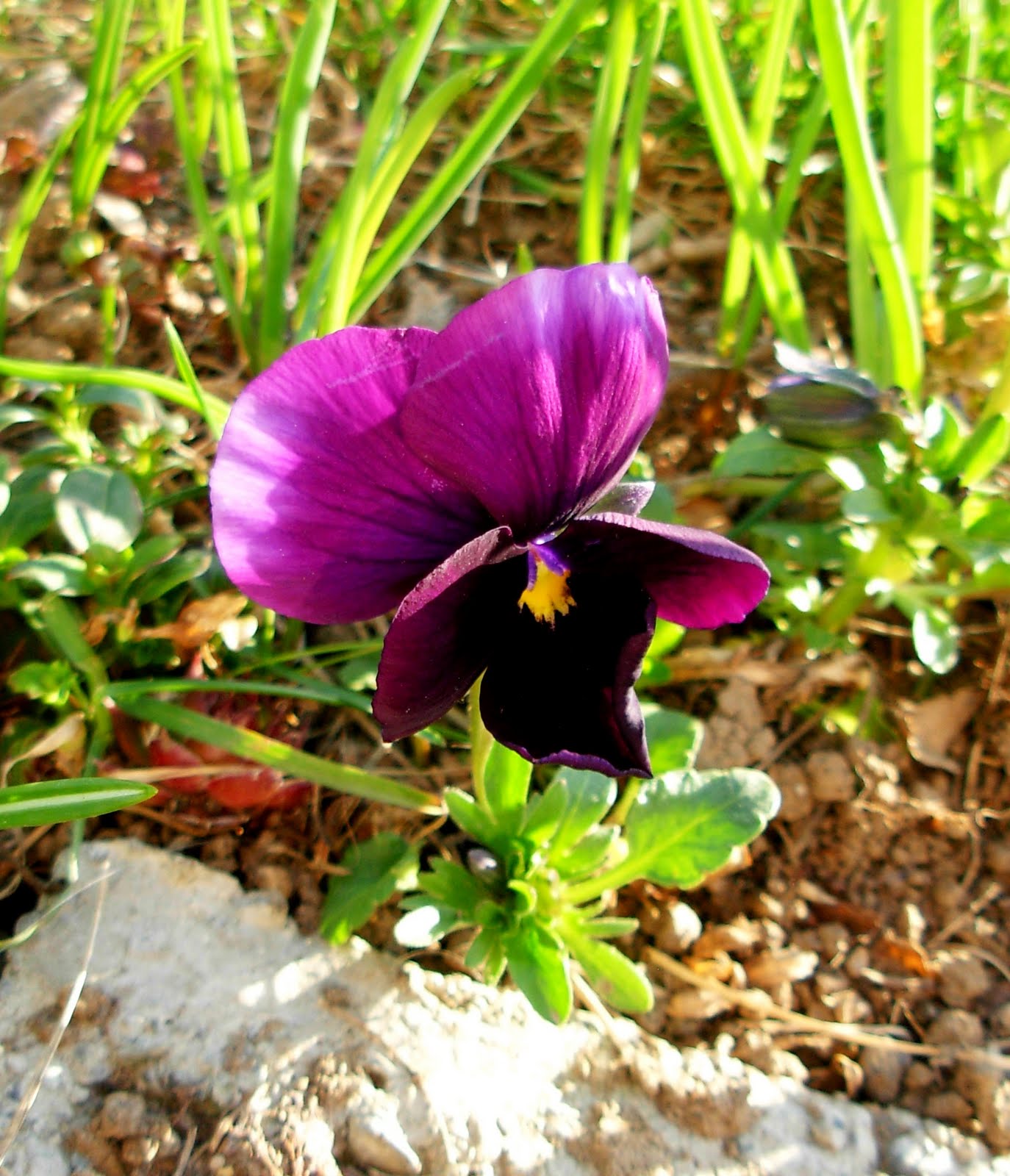
LITTLE PURPLE PANSIES

Little purple pansies touched with yellow gold,
 growing in the corner of the garden old,
we are very tiny but must try, try, try -
just one spot to gladden you and I!

I love pansies.


I learned the ditty above in Primary when I was a child.  Children still learn it and sing it. [page 244 in the LDS Children's Songbook] I think all my children learned it also.

I have a child that is a bit like a pansy - in  a good way.
She finds spots to gladden and does so.
Her talents are many - she just arrived that way!

She also arrived with bouncy curls,
long lashed bright eyes and
the widest laughing smile I had ever seen.

At birth she wore her caul like a bridal veil and throughout childhood would often place blankets, or other cloth objects over her head in a similar fashion and parade about as a 'princess' or 'bride'. She was especially fond of lace and ruffles and PINK! Purple was good but pink was mandatory - that and green - her favorite everything was green.

At age 4 she would tackle anything that came to her mind, or sight or hearing and could ride a 2 wheeler bike without training wheels.   She begged a ball of yarn and a pair of needles to knit 'like mommy' - and taught herself to do so by watching.  She made a scarf for her grandma.

She drew and painted and crafted with any and all materials available and STILL does so. Then it was egg cartons turned into carts for her pretty ponies and a small empty box from her brother's new scriptures made into a doll bed: but that is enough - this list could be unending ... but must also include a knack with animals.

(She once approached 2 fierce Dobermans, eye to eye, fearlessly and they backed away tail between legs to their open mouthed master.  She followed and patted them and they licked her 3 year old face while she threw her arms around their necks and scratched their ears.  Her cowboy grandfather said he had never seen a child that had more 'knack' with horses - she loved them and they loved her. I think she still owns the hand made bridle dad gave her.)

Now the list is even longer and she uses fancy cameras, computer programs and big girl tools like saws and drills and kitchen machines to make weddings and furniture and clothing and photos and food and every other fancy a girl or boy's mind may dream of. (And we each are just girls and boys - still.)

What is your dream? She likely could make it come true! If she wanted to - AND could find the time between her escapades.

I dabble at crafts, by comparison, but I did fancy up a small cheesecake for her birthday - I made some sugared pansies.  They make me think of all the sweet things she does to brighten every corner she occupies  

looks funky here - poor lighting and heavy sugar account for that,
the cheese cake is a nice creamy color and the pansies are pansy purple

Happy Birthday, baby girl.

Saturday, April 16, 2011

SUGAR, SUGAR

'Sugaring' edible flowers is easy and fun -

a bit painstaking perhaps - but easy AND fun!


You need: one egg white,
 a small new artist's paint brush,
edible flowers / leaves,
super fine sugar (also known as berry sugar)
and patience - loads of it!

And they have many uses,
can last months once dry and
if you have a sweet tooth are tasty.

I chose pansies for a cake topper.

Select blooms and leaves and rinse well.
 Be sure to avoid picking in areas where pesticides have been used.
Leave stems attached to make them easier to handle.
 Don't worry if they are completely dry,
just shake them free of excess water and set aside.

Separate the egg into a small shallow bowl - keep the white (it is your glue) and do what ever you wish with the yoke. One egg white will do dozens of small flowers. I have always used raw egg but if you have concerns about bacteria such as salmonella I have 'heard' meringue powder also makes an excellent 'glue'. (But I have not tried it).

Place a few spoons full of sugar into an open dish or container making sure it is free of lumps (and yes it does have to be the super fine sugar).

I always do the all backs first because the fronts show more. To make really gorgeous flowers spread the egg thinly (and some say to water it down just a little bit) so that the sugar sticks but is not too heavy.  My pictures show pansies that are actually too heavily coated. Too much egg = too much sugar coating. You can tell it is too much because the flower droops, and the coating may crack and fall off in places - NOT pretty!!

Paint the petals, one by one (first all the backs and then all the fronts) with the least amount of egg white possible but do make sure every area of the surface is shiny with a thin egg white coating.  This is the 'glue' to stick the sugar on with and it seals the finished product when dry.


For buds as pictured on the right go ahead and open them a bit to spread the egg into the crevices, as lightly as possible, using the brush tip to gently push into difficult to reach areas.


TIP: Sprinkle each petal or leaf with a dusting of sugar as you go -


Paint one, sugar it;
(these are very small leaves)


paint another, sugar it.

This is the 'patience' part.


Prop the flowers on wax paper to dry. As the sugar absorbs the moisture it becomes clear and sparkles (unless you have too much - then it stays more opaque and crusty)


The egg and sugar hardens and seals the flowers into shape. Position them attractively by gently lifting petals if need be and by laying them on shaped edges/forms (I use balls of wax paper).  Store in an airtight container when completely dry.

Violets are small and lovely on baked goods and candies.

They can be dipped into a thinned egg/water mixture and 'dropped' into the sugar. They may become a bit clumpish but because of their tiny size sometimes it is easier to do as many as possible, as fast as possible, and then select your best ones for decorations and let the others be eaten as candy.