BOTTLED

  • “Sometimes the questions are complicated and the answers are simple. Dr. Suess

Tuesday, September 23, 2014

CLAY, MARBLES, and MORE


Paleography 130

This week in our class we were assigned readings about historical writing and given a choice of several options to write with/about. Another assignment is to spend some time preserving records.
  • Write a report; 
  • Make a quill pen and ink;
  • Make some paper; 
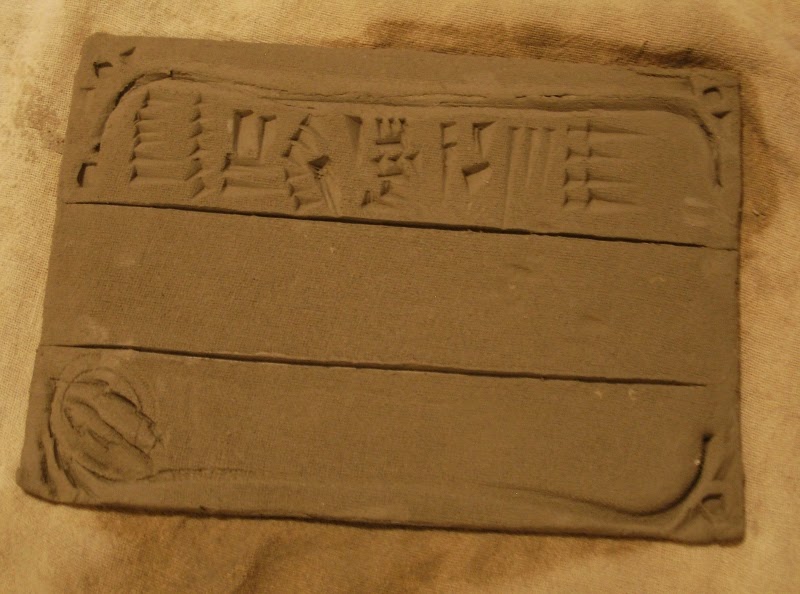
  • Make a cuneiform clay tablet 
sample letters from Wikipedia reading

I chose
     "Read the “Cuneiform” article at http://en.wikipedia.org/wiki/Cuneiform. Using modeling clay or salt dough, create a Sumerian clay tablet (does not need to exceed 3" x 5"). Using a stick, create your own cuneiform stylus."

left: cracking marble; center: wet clay marble; 
As a child, my siblings and I sometimes made marbles from slippery mud left as puddles dried after heavy rain. It would crack in slabs and curl in the sun. The back side of the slabs made excellent marbles that we would sneak into the bottom of mother’s oven. Sometimes they would crumble. We never knew which would and which would not. She was very patient, except when they blew up!

Later I learned that clay must be completely dry or it explodes during baking.

As an adult, I decided to satisfy my curiosity about why some clay crumbles and other bakes well. I checked out a stack of books from the public library and read about clay: ancient pottery and people that made it, firing, kilns, types of clay and where it can be located, and colors, etc. I never thought about colors - isn't all clay gray?

View from Google Earth, Sept 2014, of coulee 

Soil in our area was a clay "mixture." There was a ravine/coulee near my home where I remembered seeing layers and characteristics like the books described. I took a couple of buckets, a shovel, a cooperative spouse, and went for a short hike.

In the coulees there were several slide areas. I knew I was looking for the kind of “slick” feeling mud that dries to a brick-like hardness, but when wet is so sticky that it is almost impossible to wash off my hands. We found it, filled the buckets, and hiked back.

The books described a procedure for “washing” the clay to remove debris, dirt, sand, or other impurities. This involve mixing up a very watery slurry, straining it repeatedly, and letting the clay settle to the bottom (often over a period of days, with repeated stirring and straining). The dirt and most vegetation would float higher than the clay and could be poured or dipped off. The sand and small pebbles came out in the screens and sieves.

Eventually I had several small gallon containers of grayish white clay that resembled the clay I have seen in pottery shops. It was fun to play with the clay and mold it but I had no idea how to bake it, or what else to do – back to the library (pre-internet time period). The things I read about were interesting, but much more work than I wanted to attempt.

small container of dried out hard clay
One book described a process to “ripen” the clay by storing it in certain humid, temperature controlled conditions. Another detailed how some oriental artists bury it for 10 to 20 years to “cure” it, and yet another described how to harden it in large bonfires kept burning for days. Mine went into sealed buckets and was soon forgotten – but, even in long distance moves, never discarded. It had cost a bit of time and effort, and maybe someday I would use it for something.

Approximately 10 years later, while working as an ASL interpreter in a high school art class, I mentioned the clay to the teacher when the class did the unit on pottery. Mr. Brown was excited and curious. He asked if I would be willing to craft a little pot or figurine and let him experiment with baking it.

white spots on back of pig are impurities in the clay
 I made a tiny pig that fits in my hand. He fired it at about 1500° F and it turned a startling reddish-orange. He said that indicates a high iron content. He told me that even though the clay still had a few impurities that it was great, and provided 'firing' details.

before mixing and wedging

I was working 2 part time jobs, and raising a family, so the clay went back on my 'someday' priority list, and after another move took up residence in our garage. That was about 20 years ago. Last week when I read this assignment, I pulled out a small container of it, added some water to the rock-hard block, and Monday wedged it on a piece of old cotton dishtowel for the 'bat' I don't have (to help control the mess and improve consistency). A piece of heavy canvas would be better but this is what I had on hand.


Initially it was extremely soft and wet with harder drier areas but, as I kneaded, it soon became a pliable block of good clay again. I love clay! 

I couldn't resist trying a marble.

I cut a hand size lump and flattened it slightly, then folded the cloth over it and rolled it out. This helps to keep it from sticking to everything including my hands (although when clay is the correct consistency it almost cleans the hands as it sticks to itself, but I was impatient).


Yes that is my good rolling pin in the picture, but it has seen more clay than pies or cookies - a baker I am not. I cut a chunk and put the scraps back into the container.

clay sandwiched between cloth

I dug through my junk drawer and found a pair of abandoned chopsticks, and then went on the internet to learn about the writing and making a stylus. At the bottom of our Wikipedia cuneiform reading there is a helpful video about the writing. (Writing ancient Iranian cuneiform on YouTube by subject-matter expert Soheil Delshad.) I watched it several times and realized that the scribe was using one stick and it seemed to be just a simple rectangle on the end.

chopsticks left over from take out 
Cool!! I like easy. My chopsticks were almost the same shape.

wide end of chopsticks need to have sharper,
more defined corners and edges - not rounded

There were many suggestions for making a stylus, but I was gratified to see many of them suggested using wooden chopsticks. They just needed to be squared a little bit. I felt blessed! I knew I was keeping those chopsticks for something!

examples of practice writing strokes
When I went to school at age 5, we began to learn writing by making straight lines, angled lines, and last of all finally curved lines. We practiced pages and pages and pages of lines. It seemed like forever before we actually began to make actual letters, never mind words. With this in mind I did not attempt to make actual letters or words on my clay 'tablet.' I attempted to just practice the strokes and shapes I had seen and watched.


First I tried it on a scrap of clay.


I learned a lot about patience.
Clay takes a lot of patience. 
I knew that. 
I had forgotten.

Writing takes a lot of patience. I remember shedding buckets of tears when I learned to write with a pen. I kept finding mistakes in what I had already written. My father showed me how to “fix” many mistakes with some creative thinking. For example a 6 that should have been an 8 can just have the extra parts of the top half drawn in place. Whew! I didn't have to be perfect yet.

I still don’t. My tablet was a fun experiment. First I pressed a curved plastic lid along the edges to constrain the ‘text block’ and make it have a bit more eye-appeal. Then I pressed a metal set of leaves onto the lower left corner like a ‘seal,’ or stamped symbol. (When you work in clay you should always inscribe a mark that identifies your work.)


Next I drew along a straight edge with the stylus to divide the writing areas. In the top row I pressed the stylus into clay at many angles, sometimes lifting it higher and sometimes laying it almost flat. I also rotated the stylus so the wider edge was vertical and horizontal. It wasn't looking much like the triangular marks of cuneiform, so I watched the video again. I also reviewed some pictures from our Wikipedia reading.

Extract from the Cyrus Cylinder(lines 15–21),
giving the genealogy of Cyrus the Great and an
account of his capture of Babylon in 539 BC.

Phoenician alphabet

Sumerian inscription in monumental archaic style,
c. 26th century BC

I noted angles and direction of the imprints more carefully, and also noticed that for some of the broader marks the scribe pressed the stylus into the clay more than once at various different angles. I had better success when I tried again.


Then I tried to make ‘writing’ from different places and times on the second row. With my pocket knife, I shaped a smaller stylus with a longer narrower area to 'draw' or make longer marks.

trying other shapes and strokes with smaller stylus

The clay was a lot drier now and almost ideal to draw on and press marks into. It was somewhat stiff but still soft. On the third row I finally tried to mimic some of the letters/words pictured as cuneiform. Some were more pleasing than others; some were a mess. When I left it overnight to dry, it was the texture of leather and could be handled easily. 


This next morning I couldn't even tell it was drier, except that it was no longer like leather - it was stiff. It rained off and on today and my AC kept coming on – likely to remove humidity.

When making marbles it was important to keep them
similar in size to commercial marbles so that we weren't 
accused of cheating.

I got impatient, put the clay on a rack and turned my oven on low. I left the door ajar and set the rack above the open door. After a while, the top was getting fairly dry so I turned it over. The third time I did that it cracked along one of my dividing 'score' lines - maybe they were too deep.

Slip often becomes very 'creamy' but when the piece is dry
and baked only texture differences will be noticeable. 
It also dries more quickly.

I attempted to put ‘slip’ (a thin slurry of clay and water used to stick leathery unbaked clay to itself) on the back.


I wanted it to have the same texture as surrounding areas so I laid the cloth on it and pressed. DUH!! That was silly – and not patient. It broke in several places. That is when I remembered that a "slab" should have uniform thickness. To roll it to an even thickness you place it in between two matching slats of wood. You can also use a ‘form’ or ‘mold.'


I repaired the breaks using the slip and left it to dry. But I just couldn't seem to leave it alone. I moved it again and all my repairs came apart. Lucky for me I already had pictures. I had made it quite thin hoping it would dry quickly - maybe a bit too thin.


When clay is not baked, but has been shaped, it is called greenware. It is very, VERY fragile. I knew better than to move it around. My slab was in a very tender greenware stage, when just uneven finger pressure can cause damage. It was also not uniform in thickness, so even light pressure on the back caused it to crack. To handle a slab at that stage it would need to be moved lying on a flat surface. I didn't handle it properly.


When clay is baked it is much stronger. If this slab was properly fired it could be handled like any pottery plate of the same thickness. When glaze is added it is adds strength to the clay as well as a finish. This clay appears a deceptive soft- white gray, but when fired will become the common rusty, orange-red of a clay pot.


On some web sites showing cuneiform the tablets look much thicker than mine and show a more rounded sloping edge. This might make them much less fragile. If it is not baked, clay can also be recycled. As soon as water is applied, the clay readily returns to a lump that can be reworked.

soaking to become blended with main lump again

This has been a fun experiment and my tablet is going back into the lump – and likely, until my semester is over, back out to my craft room.

Shake a couple times and this is all just 'dirt' again. 
To reuse as clay I would stir and then let some moisture 
evaporate.

Friday, September 12, 2014

VEGETABLE SUPPER

Stuffed Crookneck Squash


Crookneck squash are a yellow summer squash with a tender, edible skin (unless cross pollinated and over large), and lots of vitamins and minerals. They may be almost any shade of yellow from orange-ish to green-ish, and have smooth or bumpy skin. Some may have very little 'crook,' and some may have a deep curl. Some may be cucumber or ball shaped.

From 'The Good Cook: Vegetables'
I found a delicious recipe a few years ago.
I make it when I have crooknecks.
Some crooknecks grow without a crook.
This year I was gifted some that are like baseballs.
Thanks, Jodean. I love them!!
Perfect for dinner.

ready to go into the oven

I found the recipe a bit confusing.
If you use it, read it ALL THE WAY, carefully.

I find it best to get an overall picture in my mind of what I am trying to do. In this case, I am going to cut a slice from the top of the squash, clean out the seeds, and fill it with a mixture of soft breadcrumbs, chopped squash (from the slice I cut from the top), and seasonings (onions, parsley, Parmesan, butter, salt and pepper).

I like to get all the ingredients and utensils ready, and then start cooking.

When I actually have a crookneck squash that is 'crooked' I cut a slice along the length - just enough to give me access to the seeds. The sliced top piece, and if the squash is larger often some of the solid, 'crooked' end (where there are not seeds); I parboil, chop finely, and use as part of the stuffing.

Step 1: READ the recipe!
            All the way through!
            Go shopping if you need
                  real butter,
                  fresh Parmesan,
                  fresh parsley etc.

Step 2: Pick the squash, (just saying!) or beg it from someone that has too many.

Step 3: While you are in the garden, pull an onion and pick lots of nice fresh parsley. If you didn't grow any parsley, think ahead and buy it. Fresh parsley is a key ingredient. Next year you will know better and grow some. Yes, dried parsley can be used, but I just don't think it tastes very nice - it tastes - well - dried!

Warning: Parsley tends to grow where it wants to and not where you plant it. Deal with it. The flavor is worth it.

When you come in, after you wash up, and have a snack (if you didn't have enough while in the garden eating green beans, a cuke,  and possibly a carrot or two you rubbed clean on your jeans) start a large pot of water (add a shake or two of salt) to use to parboil the squash.  And dig out the perfect sized casserole dish/pan - and turn on the oven (375°F).

just rinsed and dripping dry

Step 4: Wash the parsley and drain it well. Pat it dry if needed. Chop it into small flakes until you have a generous 1/4 cup. (I clip it with my scissors.)


Also peel the onion, and finely chop about 1/2  cup.
Set aside the onion and parsley in separate bowls to use in the stuffing.

Here you see my 'baseball' squash with a slice cut from the top.
The first cut wasn't deep enough so I just sliced deeper.
Then wash the squash, and trim the stem, blossom and any defects. I do not peel them.

If you cut a bit deep just hollow the seeds out of the 'lid.'

Step 5: Cut a slice from the top - just enough to access the seeds and clean the seeds out of the cavity. Clean all the seeds and mushy stuff out - get down to the solid flesh. Mushy stuff is yucky. No one wants mushy stuff in their mouth.

These were too small to have much 'shell.' 
Some squash may have heavy walls that need 
to be thinner.
Toss all the squash into the pot of boiling water, just long enough to partially start the cooking process. Although the recipe says to boil for about 5 minutes, if the squash are young and tender less time is needed.

Squash shells and pieces, just starting to boil.These are round 
but squash come in many shapes. On the right notice the one I 
dug too far into and took out the bottom. I chopped it and
added it to the stuffing.
Step 6: Drain and cool the squash.

How much is 1 1/2 cups?- about 4 slices. I tend to use a 
third more stuffing ingredients. I like the stuffing best, and 
sometimes make extra to pack around the squash to fill the 
dish completely. 
While the squash is cooling, I cube 5 or 6 slices of bread - or 8 . . . use lots. Do I use white or brown? Yes. I use either or both. What ever I have on hand.

I make a 'boat' of each squash so it has a shell about 1/4 -3/8" thick, depending on the size of the squash, chopping any extra flesh along with the 'slice.' I usually dice the extra into very small cubes.

Set the chopped squash bits aside with the onion and parsley to use in the filling (don't mix them yet as they cook different amounts of time).

Yes, real butter. Yes, heaping tablespoons.
Step 7: melt the 2 Tablespoons of butter and saute the onion just until clear.

I like onions. I use lots of onion. What ever 'feels' good today.

chopped squash sautéing with onion

Step 8: add the chopped squash, and stir for a minute or two until hot and then add the parsley. Stir well, tossing ingredients together thoroughly. Keep stirring.

I use lots of parsley. LOTS.
My 1/4 cup is pressed down and running ov'r
I work quickly over high heat in a cast iron pan.
Just keep stirring.
I like to get the job done.


Next add the soft bread crumbs/cubes to the same pan. Keep stirring.


Step 9: Taste - needs more butter for this much bread! Keep stirring, but keep it fluffy and light. Avoid compacting it - you may need a fork.


Next add a little salt and lots of freshly ground pepper, and last but not by any means least the freshly grated Parmesan - Be generous, and turn off the heat now.

And I needed more pepper. I like pepper. Keep fluffing.

I admit I used bottled Parmesan. I refuse to make a trip to the store for only that! However, don't tell the taste police! I could be apprehended without excuse. I know better. It really does make a difference.

Pack each shell full of stuffing. 

Step 10: Now you are ready to fill the cavities. If you have any stuffing leftover just pack it around the shells. Top with some Parmesan and bake for about 15 minutes. (My oven tends to be 'hot.')

Bake until the squash is completely tender and the stuffing hot.

Finally: Enjoy! This is excellent served with any meat or as a stand alone meal. It is tasty and filling. We have leftovers for tomorrow. We enjoy them hot or cold.


Wednesday, August 20, 2014

EDUCATION AND INSPIRATION

Online classes at BYU-Idaho use 'Discussion Boards,' a place to post comments and replies, to facilitate interactions with the instructor and between students. Often readings or assignments must be completed as the basic topic for the discussion. The following was a discussion about education.

 Discussion Board Reading "Everybody Is Ignorant, Only on Different Subjects" by Eliot A. Butler (audio)

Question by student group leader: would you consider that a man with no formal education, training, or wide/vast experience could be considered an "educated" person? As an example, let's consider the Savior. Please feel free to also use our other study readings to help substantiate your thoughts. Also, what characteristics, qualities, or accomplishments did he exhibit that help you to draw your conclusion? So, can an education be had through the Spirit? Can we be taught in ways other than in schools and academies? How do we learn?

Linda said:

I took a wee bit of exception to Brother Butler's statement, "When I hear someone say learning is fun, I wonder if that person has never learned or if he has just never had fun (page82)." He speaks of the hard work and drudgery of learning, but then on page 86 contradicts himself, somewhat, as he shows his bias about how fun learning really can be because it changes and enriches our lives even when it creates a "craving" for more "hard work."

My parents never has the opportunity to "go to school" beyond the 8th (mom) and 9th grades (dad). They learned to read, write, and do basic math AND to prize learning of every kind. I think they are educated people yet they never attended high school. They do both know how to work and how to learn and they have never stopped doing it. They taught their 11 children to love and prize learning and find joy in all aspects of living.

Imagine my surprise when I got a Facebook request to friend my father. He decided he was tired of not knowing all the stuff everyone kept saying they learned on FB, so when he turned 85, he got a computer, got help to set it up and learn the rudiments of using it, and sent out friend requests to his family and friends. He is living! He is learning! He is loving life and learning. So is mom. They are wonderful examples of being educated.

Another student said that college is hard work and that people with a college education have worked harder and are smarter. I replied:

“[Susy Somebody], you make a good point that the people with education have put in extra time to be more successful. People that complete college have worked very hard and their degrees ‘prove’ they have. Would it be possible for someone that has not attended college to ‘work’ that hard? What might ‘prove’ their work? Would it be possible for someone to ‘work’ harder than a diligent college student? How would we measure such things as ‘effort’ and ‘work?’ Wouldn't it be fascinating to study and tabulate such statistics?

“With no intent to offend, I must disagree with you. I think that people that attend college may or may not be ‘smarter,’ and that although they do work hard, that the work they do is not always more or harder than the work of learning that people without the chance for college do (and anyone can do ‘extra’ work). The people that do not get to go to college have different stresses. They have to deal with working harder than someone that happens to have a chance to get a degree so they can obtain the same (or more) experience. Consider the stress of learning and adapting ‘on the job’ when they have been denied opportunities for formal education. Now that is work! It is also a willingness to learn that many that attend college never attain.

“My father worked as a general contractor and handyman rancher. He learned from his father who learned from his father. During harvest seasons formal schooling always waited until work that sustained life was complete. Although he had no papers to prove it, his reputation (as a skilled a highly competent contractor) provided more work than he could do and he often ran multiple crews trying to accommodate all the ‘jobs’ he had requests for.

“Once he was referred to be a foreman on a large government project but could only be hired as a laborer because he had no papers. He never complained he just took the lower paying job because it was an opportunity to increase his experience and contacts - and a unique project he wanted to be a part of.

“The ‘foreman’ that had degrees and papers had no real on the job experience, but his resume was wonderful. He did not, however, really understand what the actual work entailed or how to manage crews. Within a short time, the work demanded of workers had to be done over, men were walking off the job in frustration, and a few months later he was fired. Meanwhile my father's common sense solutions, (and support to other men he worked with) and daily, diligent efforts proved his ability and by the time the foreman was fired he was requested to fill the position. Many ‘get’ to attend college. Do they ‘learn’? And do they ‘love it?’”

In reply to the further questions: "Can an education be had through the Spirit? Can we be taught in ways other than in schools and academies? How do we learn?"

I think that part of our experience at BYU-I is to teach us how to achieve that kind of learning -- it is part of what the BYU-I Learning Model is about. Using my father's jobs as an example again – see my reply to Susy above - Can you tell I admire dad a lot? He is not perfect, just available readily to use as an example: He was one of the workers that helped remodel and renovate the Cardston, Alberta Temple (a 3 year process). There is a bas relief, by Torleif Knapfus titled 'Christ the Fountainhead,' depicting the Savior with the woman at the well, on the front of the temple (can be seen here at this link and at the top of the page).
When I was a child our Primary would at times go there and touch it or have pictures taken with it as a group. When first built there was a fountain below it, to reflect the image. The pool was later removed.

The temple had an entry added in the "restoration" work and that area was enclosed. As part of temple's preservation and being returned to its historical state, the fountain with a pool of water below the frieze was re-built. Because of the unique architecture and the challenges faced, some had difficulty to quite figure out how to accomplish what the architects wanted the pool to be formed like.

Some voiced that the "planned renovation" was impossible and could not be done. My father was asked by those that knew him best if he could suggest any solutions. He accepted the invitation. He took careful measurements, reviewed the blueprints with the engineers and pondered it for a day or two.

Later, to me, he described a marvelous process of prayer and inspiration. He knew, and he wanted me to know, that the Lord could teach him how to set up the forms and prepare the site for the construction of the pool there. He said he was led along not always knowing what the next step might be, but carefully proceeding (based on broad experience and knowledge) as he "felt" he should, always discussing his ideas with the engineers and site supervisors, as well as the Lord. He successfully built and placed forms for the pool that now exists inside the Cardston Alberta Temple.

Thursday, July 10, 2014

PENCIL

For my 1st English class we had to write a "This I Believe" essay, and make a short screen-cast. For me it was very difficult. I had never done such a thing before. The result did get me an excellent grade but I was very stressed. I did not publish to the 'This I Believe' website.

I have finally decided to share the essay and screen-cast. If the link doesn't work just copy this information ( http://screencast.com/t/Yp37RwuwDe ) to your browser and wait for the screen-cast to load.


FDEng 101~ 66
Elisabeth Thomas
14 October 2013

Pencil . . . and Erasures

I like short pencils. I don’t break pencils in half on purpose, but I prefer that length; and yes, I most often write in pencil. My husband, on the other hand, likes new pencils. We are a pair.


As his long pencils become “too short,” I acquire perfect just-my-size pencils to wear out. Let me, however, clarify. I believe in pencil—not pencil as a noun: an inexpensive “instrument having a tapered point for its application”[1] in drawing, marking, or writing; but pencil as a verb: a process of action and ongoing change for the making of non-permanent impressions, as may occur during the use of a pencil (or other objects) to “outline, sketch, or delineate.”[2]


“Pencil” is the easily-smeared, simple-to-change and re-order, uncommitted-gray evidence of evolving life. It is what occurs prior to inked permanence. Pencil is readily “rubbed out, effaced, expunged, and obliterated.” It can “utterly cease to exist.”[3] Pencil is the ability to tentatively try, erase mistakes, and try again to improve error and success. I like that erasures eradicate. Pencil permits me to experiment, to attempt all things without the necessity to be perfect—yet. It may begin with a clearly defined point, but often finds its greatest value long after, down among rounded, fat, smudged, hasty scribbles jotted before (and even as) the scratching wood compels a pause that re-sharpens or shapes an instrument, thought or action.


At heart I am an artist. I revel in music, art, dance, and literature, yet can only execute discordant notes, simple sketches, and stumbling steps; and when I write, words pile upon hasty words spilling directly from mind to page. I am a novice.

Although I accept I have not (and may never) master any endeavor, I am in awe of talent of all kinds. I love sports, but you would pick me last to be on your team.Science and mathematics astound my mind, but I fail to grasp more than the edge of a vision of possibilities.


I do have talents. They begin with what I do best—trying. I do what I can to satiate my visceral hunger to perfect my existence by focusing on what I can do—leaving ignored absolutes of cannot. When accidents took my ability to run I learned, with great effort, to walk. After multiple piano teachers asserted, “lessons are wasting your money,” I continued to teach myself—constantly accessing new resources to train my mind and hands. I continue to practice.

I live in the same manner. In admiration of the greatest and noblest ideals, constantly seeking to follow inspiring examples, I pencil my ideas and acts next to those of the masters. I am continually comparing, erasing, adjusting, rearranging and re-ordering myself—I know I can become something more than I now am. I am not ready to be inked yet. I am willing to do and become better. I believe in pencil . . . AND erasures.


[1] Oxford English Dictionary, I 2
[2] Ibid I b
[3] Ibid see Erasures

Friday, July 4, 2014

FRIDAY - IN THE DARK

Today is Friday. My favorite holiday is on Friday.

My favorite holiday is Good Friday.
What does that even mean?

I can only answer that for myself.
We must each find such meanings in our private ponderings.

I find expression of some answers in words spoken in Oct 2006 by Joseph B. Wirthlin, Apostle of Jesus Christ, and member of the Twelve Apostles in The Church of Jesus Christ of Latter Day Saints.

     "I think of how dark that Friday was when Christ was lifted up on the cross. On that terrible Friday the earth shook and grew dark ... evil men who sought his life rejoiced ... the veil of the temple was rent in twain ...

     "On that Friday the Apostles were devastated. Jesus, their Savior - the man who had walked on water and raised the dead - was Himself ... [seemed] overcome by His enemies.

     "On that Friday the Savior of mankind was humiliated and bruised, abused and reviled. It was a Friday filled with devastating, consuming sorrow that gnawed at the souls of those who loved and honored the Son of God  ... of all the days since the beginning of this world's history, that Friday was the darkest."

I have dark days in my life.

Days that seem like all light and hope is extinguished. Days and/or nights that seem to have no end.

Times of utter despair.

I suspect you do also.

I hope not, but also know it is part of living and dying, loving, serving and trying.


With rain, sometimes, we may ... if we wipe our eyes and lift them to look -

glimpse a rainbow, God's promise of hope to man.

Elder Wirthlin continues,

     "Each of us will have our own Fridays - those days when the universe itself seems shattered and the shards of our world lie littered about us in pieces. We all will experience those broken times when it seems we can never be put together again. We will all have our Fridays.

     "But I testify to you in the name of the One who conquered death - Sunday will come. In the darkness of our sorrow, Sunday will come.

     "No matter our desperation, no matter our grief, in this life or the next, Sunday will come."[emphasis mine]

I join my voice to Elder Wirthlin.

SUNDAY WILL COME.

And every Sunday I will look again at the white cloth covering the sacrament table and remember the corpse of the Savior and then eat and drink the symbols of His triumph! His triumph that dispels my darkness. Dispels all darkness of all such 'Fridays'.

And with Elder Writhlin I will rejoice and

     " ... live in thanksgiving for the priceless gifts that come to us as [children] of a loving Heavenly Father and for the promise of that bright day when [I] shall rise triumphant from the grave. No matter how dark [my] Friday, Sunday will come.

     "The Resurrection transformed the lives of those who witnessed it. Should it not transform ours? We will all rise from the grave. On that day we will know the love of our Heavenly Father and will rejoice that the Messiah overcame all that we could live forever."

For now I listen to the advice of Isaiah in chapter 24 (verse 14) and sing in the darkness, "Glory to God on high ... tell what his arm has done, what spoils from death he won ..Praising His name ..." hymn 67

After the cold of Winter, Spring brought the change of seasons - the daffodils - the birds - the green - the light ... and now Summer has arrived,

And Sunday will come - even should seasons fail - even in the dark!

Monday, June 23, 2014

IN THE MIDDLE

Many years ago . . .

Staring into the face of a newborn granddaughter
I thought I saw my mother.

I raised my eyes in wonder to her mother's, my youngest daughter.

She laughed at my expression and simply stated,
"She looks like you doesn't she!"

mother and daughter

I realized in that instance that I mirror my own mother.

mother and daughter

I am surprised because I always thought she looks like her mother.

Elna left, daughter Elna Jean right

Yet I've never thought that I look like my grandmother.

We are completely alike but distinctly different.


I am in the middle of generations

In the eyes of a grandchild I see history.

History fascinates me.

Family history enthralls me.

I make discoveries there.

In them I find myself.


Sunday, June 1, 2014

PRAY ON

In my New Testament class, each week we post principles found in our reading. Benjamin Davis posted the following.

FAITH and PRAYER

True faith may sometimes be found, 
where it might have been least expected.

[A story in Matthew 15:21-28 illustrates great faith.

  21 ¶Then Jesus went thence, and departed into the coasts of Tyre and Sidon.

  22 And, behold, a woman of Canaan came out of the same coasts, and cried unto him, saying, Have mercy on me, O Lord, thou Son of David; my daughter is grievously vexed with a devil.


  23 But he answered her not a word. And his disciples came and besought him, saying, Send her away; for she crieth after us.


  24 But he answered and said, I am not sent but unto the lost sheep of the house of Israel.


  25 Then came she and worshipped him, saying, Lord, help me.


  26 But he answered and said, It is not meet to take the children’s bread, and to cast it to dogs.


  27 And she said, Truth, Lord: yet the dogs eat of the crumbs which fall from their masters’ table.


  28 Then Jesus answered and said unto her, O woman, great is thy faith: be it unto thee even as thou wilt. And her daughter was made whole from that very hour.]

What encouragement there is [in this story] to persevere in prayer, both for ourselves and others!

It is hard to conceive a more striking illustration of this truth, than we have in this passage. The prayer of this afflicted mother at first seemed entirely unnoticed--Jesus "answered her not a word" (verse 23). Yet she prayed on. 

The answer which by and bye fell from our Lord's lips sounded discouraging--"I wasn't sent to anyone but the lost sheep of the house of Israel" (verse 24). 

Yet she prayed on, "Lord, help me" (verse 25). 

The second answer of our Lord was even less encouraging than the first--"It is not appropriate to take the children's bread and throw it to the dogs" (verse 26). 

Even then she was not silenced. Even then she finds a plea for some "crumbs" (verse 27) of mercy to be granted to her. And her importunity obtained at length a gracious reward. "Woman, great is your faith! Be it done to you even as you desire" 
(verse 28). 

"Seek and you shall find" (Matt. 7:7). 
That promise never yet was broken, 

Let us remember this story, when we pray for ourselves. We are sometimes tempted to think that we get no good by our prayers, and that we may as well give them up altogether. Let us resist the temptation. It comes from the devil. Let us believe, and pray on. 

Let us believe, and pray on. Against our besetting sins, against the spirit of the world, against the wiles of the devil, let us pray on, and not faint. 

Let us believe, and pray on. For strength to do duty, for grace to bear our trials, for comfort in every trouble, let us continue in prayer. Let us be sure that no time is so well-spent in every day, as that which we spend upon our knees. Jesus hears us, and in his own good time will give an answer.

Let us remember this story, when we intercede for others. Those who have children, [or] whose conversion we desire? Those who have relatives and friends, about whose salvation we are anxious? Let us follow the example of this Canaanitish woman, and lay the state of their souls before Christ. 

Let us name their names before Him night and day, and never rest until we have an answer. We might have to wait a long time. We may seem to pray in vain, and intercede without profit. But let us never give up. 

Let us believe that Jesus is not changed, and that He who heard the Canaanitish mother, and granted her request, will also hear us, and one day give us an answer of peace.