BOTTLED

  • “Sometimes the questions are complicated and the answers are simple. Dr. Suess

Wednesday, July 1, 2015

O CANADA


Happy Dominion Day, fellow Canadians.

Here's a tiny bit of history  trivia courtesy of my daughter,  Kimber, AKA Mrs. Lybbert. This morning she composed a pop quiz for her Advandced Placement [AP] Conference classmates. She asked, “ What popular early twentieth century song, written by a teacher and quoting Tennyson, will be sung by millions of people today?


O Canada!
Our home and native land!
True patriot love in all thy sons command.
With glowing hearts we see thee rise,
The True North strong and free!
From far and wide,
O Canada, we stand on guard for thee.
God keep our land glorious and free!
O Canada, we stand on guard for thee.

"O Canada" is the national anthem of Canada. The song was originally commissioned by Lieutenant Governor of Quebec Théodore Robitaille for the 1880 Saint-Jean-Baptiste Day ceremony; Calixa Lavallée composed the music, after which words were written by the poet and judge Sir Adolphe-Basile Routhier (May 8, 1839 – June 27, 1920), whose occupation was lawyer, author, judge, and professor.

Sir Adolphe-Basile Routhier was a Canadian judge, author, and lyricist . He wrote the lyrics of the original French version of the Canadian national anthem O Canada. He was born in Saint-Placide, Quebec, to Charles Routhier and Angélique Lafleur.

Official French

Ô Canada!
Terre de nos aïeux,
Ton front est ceint de fleurons glorieux!
Car ton bras sait porter l'épée,
Il sait porter la croix!
Ton histoire est une épopée
Des plus brillants exploits.
Et ta valeur, de foi trempée,
Protégera nos foyers et nos droits.

Translation of French:

O Canada!
Land of our forefathers,
Thy brow is wreathed with a glorious garland of flowers.
As is thy arm ready to wield the sword,
So also is it ready to carry the cross.
Thy history is an epic
Of the most brilliant exploits.
Thy valour steeped in faith
Will protect our homes and our rights.


The lyrics were originally in French and an English version was created in 1906. Robert Stanley Weir wrote in 1908 another English version, which is the official and most popular version, one that is not a literal translation of the French. Weir's lyrics have been revised twice, taking their present form in 1980, but the French lyrics remain unaltered. "O Canada" had served as a de facto national anthem since 1939, officially becoming Canada's national anthem in 1980 when the Act of Parliament making it so received Royal Assent and became effective on July 1 as part of that year's Dominion Day celebrations.

It has been noted that the opening theme of "O Canada" bears a strong resemblance to the "March of the Priests" from the opera The Magic Flute, composed in 1791 by Wolfgang Amadeus Mozart. The line "The True North strong and free" is based on the Lord Tennyson's description of Canada as "that true North, whereof we lately heard / A strain to shame us". In the context of Tennyson's poem To the Queen, the word true means "loyal" or "faithful".


"To the Queen" Alfred Tennyson, 1809-1892


O LOYAL to the royal in thyself,
And loyal to thy land, as this to thee--
Bear witness, that rememberable day,
When, pale as yet, and fever-worn, the Prince
Who scarce had pluck'd his flickering life again
From halfway down the shadow of the grave,
Past with thee thro' thy people and their love,
And London roll'd one tide of joy thro'all
Her trebled millions, and loud leages of man
And welcome! witness, too, the silent cry,                10
The prayer of many a race and creed, and clime--
Thunderless lightnings striking under sea
From sunset and sunrise of all thy realm,
And that true North, whereof we lately heard
A strain to shame us 'keep you to yourselves;
So loyal is too costly! friends--your love
Is but a burthen: loose the bond, and go.'
Is this the tone of empire? here the faith
That made us rulers? this, indeed, her voice
And meaning, whom the roar of Hougoumont         20
Left mightiest of all peoples under heaven?
What shock has fool'd her since, that she should speak
So feebly? wealther--wealthier--hour by hour!
The voice of Britain, or a sinking land,
Some third-rate isle half-lost among her seas?
There rang her voice, when the full city peal'd
Thee and thy Prince! The loyal to their crown
Are loyal to their own far sons, who love
Our ocean-empire with her boundless homes
For ever-broadening England, and her throne          30
In our vast Orient, and one isle, one isle,
That knows not her own greatness: if she knows
And dreads it we are fall'n.--But thous, my Queen,
Not for itslef, but thro' thy living love
For one to whom I made it o'er his grave
Sacred, accept this old imperfect tale,
New-old, and shadowing Sense at war with Soul
Rather than that gray king, whose name, a ghost,
Streams like a cloud, man-shaped, from mountain peak,
And cleaves and cromlech still; or him                    40
Of Geoffrey's book, or him of Malleor's one
Touch'd by the adulterous finger of a time
That hover'd between war and wantonness,
And crownings and dethronements: take withal
Thy poet's blessing, and his trust that Heaven
Will blow the tempest in the distance back
From thine and ours: for some are scared, who mark,
Or wisely or unwisely, signs of storm,
Waverings of every vane with every wind,
And wordy trucklings to the transient hour,             50
And fierce or careless looseners of the faith,
And Softness breeding scorn of simple life,
Or Cowardice, the child of lust for gold,
Or Labour, with a groan and not a voice,
Or Art with poisonous honey stol'n from France,
And that which knows, but careful for itself
And that which knows not, ruling that which knows
To its own harm: the goal of this great world
Lies beyond sight: yet--if our slowly-grown
And crown'd Republic's crowning common-sense,   60
That saved her many times, not fail--their fears
Are morning shadows huger than the shapes
That cast them, not those gloomier which forego
The darkness of that battle in the West,
Where all of high and holy dies away.


from The Works of Alfred Lord Tennyson, Poet Laureate (London: Kegan Paul, 1878).

Sunday, June 21, 2015

BUILDING

Happy Father's Day

Anyone need a whisker rub? He had the look long before it was a fad.
 ("Whisker rubs" were usually reserved for anyone being cranky.)
And look at that twinkle in his eye.
Dear Dad:

Naturally, although we have never seen you do it, you can walk on water - right? I mean, why "sink or swim" if you can "walk on water"? From you (and mother) we learned faith. When we have faith, and turn to the Savior, we can walk on water.

1991 Mission to Los Angles, California, building the "kingdom"

You were always building something, but I think the most important thing you ever built was a family. You are a solid foundation each one of your family depends upon.

Trailer built on rear axle and bed of an old truck

And with a good foundation, anything can be built, and when needed repaired.

Repairing spring horse,
 but there sure was a lot of teasing about looking like this pony dumped you. 
We watched you.
We learned if you get "bucked off" just try again.
You can always try again.

How many pancakes have you made over the years?
How high can we count?

And of course a pancake, made with 'Cackle Berries' and 'Moo-Juice' was a great way to start the day, once you were 'up-and-at 'em,' and had 'that mattress off your back.'

And most of the other important lessons of life we heard as you worked and sang about "Swingin' on a Star:" Set our sites on the stars, don't be as stubborn as a mule, stay in school, be clean, have good manners, work hard, learn to read and write, those that are "slippery" will get caught, and of great importance - ALL the monkeys aren't in the zoo! Beware that we're not acting like a monkey!

Quilt, by Kimber for 2007 auction

What does it take to swing on a star?


Would you like to swing on a star?
Carry moonbeams home in a jar
And be better off than you are
Or would you rather be a mule?

A mule is an animal with long funny ears
Kicks up at anything he hears
His back is brawny but his brain is weak
He's just plain stupid with a stubborn streak
And by the way, if you hate to go to school
You may grow up to be a mule

Or would you like to swing on a star?
Carry moonbeams home in a jar
And be better off than you are
Or would you rather be a pig?

A pig is an animal with dirt on his face
His shoes are a terrible disgrace
He has no manners when he eats his food
He's fat and lazy and extremely rude
But if you don't care a feather or a fig
You may grow up to be a pig

Or would you like to swing on a star?
Carry moonbeams home in a jar
And be better off than you are
Or would you rather be a fish?

A fish won't do anything, but swim in a brook
He can't write his name or read a book
To fool the people is his only thought
And though he's slippery, he still gets caught
But then if that sort of life is what you wish
You may grow up to be a fish

And all the monkeys aren't in the zoo
Every day you meet quite a few
So, you see it's all up to you
You can be better than you are
You could be swingin' on a star


Thursday, April 23, 2015

NO MIRACLE

Jesus healed many people.

Why not me?

A lame man may have had this question.

The man is described in Acts chapter 3.

Verse 2 records "And a certain man lame from his mother’s womb was carried, whom they laid daily at the gate of the temple which is called Beautiful, to ask alms of them that entered into the temple."

How is this possible? 

Do you ever feel like you wait at the "gate" of the temple, and even at heaven's door for a miracle that is not forthcoming? 

Was this lame man not at the temple gate when Jesus was?

Acts is the record of the things the apostles did after Christ's death. Jesus Christ, resurrected, ministered to the apostles 40 days. Acts chapter 1 describes how Jesus returned to heaven.

Acts 3 tells how the lame man was healed at the temple by Peter and John, sometime later, AFTER Christ's crucifixion, and resurrection, ministry, and return to heaven. Acts 4: 22 tells us "the man was above forty years old, on whom this miracle of healing was shewed."

FORTY years of age?
Where was he when Jesus came and went from the temple?

While Jesus lived on earth the blind saw, the deaf heard, the lame leaped by His power and miracles. Through his name and power, the rotted flesh of lepers "came again like unto the flesh of a little child" (2 Kings 5:9), and of even greater significance sins were forgiven—washed completely away, and forgiven.

Mathew 11:5 tells us, "The blind receive their sight, and the lame walk, the  lepers are cleansed, and the deaf hear, the dead are raised up, and the poor have the gospel preached to them."

We know from many sources, and specifically from Matthew 21:14 that "the blind and the lame came to [Jesus] in the temple; and he healed them."

How is it then that a 40 year old man, lame from his mother's womb, "laid at the gate of the temple daily" was still at the gate of the temple when Peter and John came?

The story (Acts 3: 4-13) tells us: 

"Peter, fastening his eyes upon him with John, said, Look on us. And he gave heed unto them, expecting to receive something of them. Then Peter said, Silver and gold have I none; but such as I have give I thee: In the name of Jesus Christ of Nazareth rise up and walk.

"And he took him by the right hand, and lifted him up: and immediately his feet and ankle bones received strength. And he leaping up stood, and walked, and entered with them into the temple, walking, and leaping, and praising God.  And all the people saw him walking and praising God:

"And they knew that it was he which sat for alms at the Beautiful gate of the temple: and they were filled with wonder and amazement at that which had happened unto him. And as the lame man which was healed held Peter and John, all the people ran together unto them in the porch that is called Solomon’s, greatly wondering.

"And when Peter saw it, he answered unto the people, Ye men of Israel, why marvel ye at this? or why look ye so earnestly on us, as though by our own power or holiness we had made this man to walk? The God of Abraham, and of Isaac, and of Jacob, the God of our fathers, hath glorified his Son Jesus . . . ."

Peter witnessed that this man was healed so that the people could receive a sure witness of the divinity of Jesus Christ, and that His power and gospel remained on the earth.

Prophets teach us to go to the temple when we are troubled, to seek peace and healing there. As we wait at the temple praying for a miracle do we have faith and trust like this man apparently had?

Do we trust God?

Can we accept His omniscience?

Especially when we feel we have been bypassed?

Even when miracles happen for all around us?"

Particularly when we have cause to question: "Why not me?"


Thursday, February 26, 2015

PARENTING

In FAML100 this week we are studying the practices of parenting. Last week we studied the principles of parenting. In long-term ongoing studies, out of all the varied parenting styles, authoritative parenting  (note: this is different than authoritarian coercive parenting) consistently shows the best long term outcomes and health, mentally and physically. Spanking is not desirable. There are better ways.

Our teacher posted a link to an infographic showing details. I recommend it. Scroll down a way to see the infographic. We had a number of activity choices and questions to answer. I chose the following:

Q: Your older sibling calls you. “Since you’re the big expert in parenting and families, tell me what I’m supposed to do about my 6-year old son who throws a fit every time we...” How do you respond? 

First I would laugh right out loud (didn't we recently have a conversation and I thought he was the expert?), then commiserate about my own child (grandchild), and reassure my sibling that his 6 year old son (or grandson) is going through a normal stage of childhood.

Prosocial values, like caring for close family, cooperating with other children, and not hurting anyone intentionally can be seen early in some children, but just as often they are not. I would tell my sibling that in my Child Development Class we learned that “many lines of research have shown that children develop their own morality, guided by peers, parents and culture” (The Developing Person, p. 402) and they do so on their own unique timetable. His 6 year old will be fine, mostly because of the examples of loving and kind parents, and grandparents, and even Aunts and Uncles. I pledge to be kind to that 6 year old, especially when I felt like sending him straight home!

During this age children typically become more systematic, objective, and their learning increases exponentially. Before age 5 children are eager to talk and think, but they do not always understand all that is said, and only gradually come to understand things from other viewpoints. Parents’ underlying attitudes and examples are crucial to model the types of behaviors they expect their children to learn. 

The Proclamation teaches: “Parents have a sacred duty to rear their children in love and righteousness, to provide for their physical and spiritual needs, and to teach them to love and serve one another, observe the commandments of God, and be law-abiding citizens wherever they live.” Children from every ethnic group and every culture benefit if they believe that they are appreciated; children everywhere suffer if they feel rejected and unwanted.

As children’s thinking and reasoning processes develop, their brains are growing rapidly. They are developing a sense of who they are and their needs should be respected. They have learned “I am”—their existence as a distinct person, and they often think they are best at everything. The more we can validate their existence and the wonderful abilities they are developing the happier they become. At this age young children are only just beginning to apply new skills to things in their own experiences—to situations with visible, tangible, real things (not abstractions). They are not logical, sometimes confusing lies and wishes, and forgetting why they are punished.

We also learned in Child Development that at age 5 most children can count to 100, but not until about age 8 can they estimate where on a number line a particular two digit number would be placed. They are just starting to learn to arrange things into logical series and infer or transfer information as they figure out how one fact is linked to another, and how those facts affect them. If John is taller than Jim, and Jim is taller than David, who is taller John or David? Being able to understand and answer these types of thinking tests is part of normal development that can happen at different ages for each child (The Developing Person, p. 352, 356). 

My darling nephew (or grandson) is doing his best to correlate the massive amounts of information he is learning and make sense of it—and his dad (and mom) need to help.

Good caregiving is not achieved by following any one simple rule; children’s temperaments vary, and so do cultural patterns. All children need guidance [and] there are many ways to provide it. Because early childhood is a critical time for teaching moral behavior parents need to establish healthy boundaries and consequences.

Ideally, adults anticipate misbehavior and guide children toward patterns of behavior and standards of morality that develop from within the child’s self, taking into account the unique circumstances of the child, but misbehavior cannot always be prevented. 

 Nevertheless, children’s “brains are especially attuned to their own repeated social experiences . . . [as] the parts of the cortex dedicated to the senses develop,” and research demonstrates that this is a crucial time of brain growth that is heavily influenced by environment and interpersonal relationships (The Developing Person, p. 142). 

When they are engaged in positive activities, problems become less frequent as their minds and energies are directed and involved. Often simple awareness prevents incidents, especially among the young. Almost all children like to engage adults in conversation and activities, and are readily distracted or encouraged to other things if adults watch for warning signs and prevent critical situations from starting.

Elder Quentin L Cook teaches, “How we treat those closest to us is of fundamental importance. Violence, abuse, lack of civility, and disrespect in the home are not acceptable—not acceptable for adults and not acceptable for the rising generation. . . . Regardless of the culture in which we are raised, and whether our parents did or did not abuse us, we must not physically, emotionally, or verbally abuse anyone else. . . .The need for civility in society has never been more important. The foundation of kindness and civility begins in our homes” (Oct 2012, Can You Feel So Now?). 

 It is important to teach and model appropriate interpersonal interactions to children and youth. Hitting is not OK! Name calling is not OK! Unkind words and actions need to stop! What teachers and parents model, children follow.

My advice? "Take a deep breathe, and enjoy!" This is one of the most fun and amazing stages in a child's life.

Thursday, February 19, 2015

POEMS

In an attempt to collect poems I have memorized or that have had significant influence in my life to one place I have decided to publish them here on my blog. They will appear randomly as they come to mind or I find sources for the exact words.

Abou Ben Adam

Jonathan Bing

Jonathan Bing Does Arithmetic

Indipsensible Man

Laughin'

You Are Old Father William


Wednesday, February 18, 2015

JONATHAN BING DOES ARITHMETIC


Jonathan Bing Does Arithmetic

by Beatrice Curtis Brown (1901-1974)

When Jonathan Bing was young, they say,
He slipped his school and ran away;
Sat in the meadow and twiddled his thumbs
And never learnt spelling or grammar or sums.

So now if you tell him, “Add one to two”,
“Explain what you mean,” he’ll answer you,
“Do you mean 2-morrow or that’s 2 bad?
And what sort of 1 do you want me to add?

“For there’s 1 that was first when the race was 1,
(For he ran 2 fast for the rest to run).
But if 2 had 1 when the race was through,
I’d say your answer was 1 by 2.”

“Oh Jonathan Bing, you haven’t the trick
Of doing a sum in arithmetic.”
“Oh give me a chance, just one more try,”
Says Jonathan Bing with a tear in his eye.

“Very well, Jonathan, try once more,
Add up a hundred and seventy-four.”
“A hundred, and seventy-four,” says he,
“Why — that’s a great age for a person to be!”

Says Becky from Poetry Friday: "from my ragged old copy of the Arrow Book of Funny Poems, collected by Eleanor Clymer (Scholastic, 1961), originally published in Jonathan Bing and Other Poems, 1936."

Tuesday, February 17, 2015

POOR OLD JONATHAN BING


 By Beatrice Curtis Brown

Poor old Jonathan Bing
Went out in his carriage to visit the King,
But everyone pointed and said, "Look at that!
Jonathan Bing has forgotten his hat!"

Poor old Jonathan Bing
Went home and put on a new hat for the King,hat
But by the palace the soldier said, "Hi!
You can't see the King; you've forgotten your tie!"

Poor old Jonathan Bing,
He put on a beautiful tie for the King,
But when he arrived, and Archbishop said, "Ho!
You can't come to court in pajamas, you know!"
Jonathan BingJonathan Bing's house

Poor old Jonathan Bing
Went home and addressed a short note to the King:
"If you please will excuse me, I won't come to tea;
For home's the best place for all people like me!"


YOU ARE OLD, FATHER WILLIAM

You are old, Father William,” the young man said,
“And your hair has become very white;
And yet you incessantly stand on your head –
Do you think, at your age, it is right?”

“In my youth,” Father William replied to his son,
“I feared it might injure the brain;
But, now that I'm perfectly sure I have none,
Why, I do it again and again.”

“You are old,” said the youth, 
                                      “as I mentioned before,
And have grown most uncommonly fat;
Yet you turned a back-somersault in at the door –
Pray, what is the reason of that?”

“In my youth,” said the sage, 
                              as he shook his grey locks,
“I kept all my limbs very supple
By the use of this ointment – one shilling the box –
Allow me to sell you a couple?”

“You are old,” said the youth, 
                                  “and your jaws are too weak
For anything tougher than suet;
Yet you finished the goose, 
                                   with the bones and the beak –
Pray how did you manage to do it?”

“In my youth,” said his father, “I took to the law,
And argued each case with my wife;
And the muscular strength, which it gave to my jaw,
Has lasted the rest of my life.”

“You are old,” said the youth, 
                                     “one would hardly suppose
That your eye was as steady as ever;
Yet you balanced an eel on the end of your nose –
What made you so awfully clever?”

“I have answered three questions, 
                                       and that is enough,”
Said his father; “don't give yourself airs!
Do you think I can listen all day to such stuff?
Be off, or I'll kick you down stairs!”


Poem written by Lewis Carroll in the mid 1800's.

Monday, February 16, 2015

INDISPENSABLE MAN


"Indispensable Man"


Saxon White Kessinger

Sometime when you’re feeling important;
Sometime when your ego’s in bloom
Sometime when you take it for granted
You’re the best qualified in the room,

Sometime when you feel that your going
Would leave an unfillable hole,
Just follow these simple instructions
And see how they humble your soul;

Take a bucket and fill it with water,
Put your hand in it up to the wrist,
Pull it out and the hole that’s remaining
Is a measure of how you’ll be missed.

You can splash all you wish when you enter,
You may stir up the water galore,
But stop and you’ll find that in no time
It looks quite the same as before.

The moral of this quaint example
Is do just the best that you can,
Be proud of yourself but remember,
There’s no indispensable man.


From Apple Seed website

"Indispensable Man" was originally published in "The Nutmegger Poetry Club under the name Saxon Uberuaga. It has also been published in "Boots" in Spring 1993, in "The Country Courier" 1996, "Rhyme Time" in Winter 2000, and in "Golden Times" in August 2003.

Saxon White Kessinger is a member (and past president) of Gem State Writers’ League and a member of Idaho Writers’ League. She is an award winning writer, receiving Idaho Writers’ League "2003 Lifetime Achievement Award," "Writer of the Year" in 1992, 1995, and 2002 and "Poet of the Year" in 1999 and 2000 from her Idaho State Leagues. She has published various poetry offerings and many articles in various newspapers and magazines. You can reach the author by email at poetsaxon@juno.com

Sunday, February 15, 2015

SLIPPERS

I do not wear slippers.
Never have.

BUT, what about these?
These are shiny silver dots (not white).


If my feet (rarely) are cold I get a pair of socks. Last time I was hospitalized they provided a pair of grey fuzzy ankle socks with grippers.

They are actually my favorite foot solution.

BUT, these are pretty funky!
I think I could wear these.
At least for those few times needed.


Yeap! These feel pretty good.


And the comparison is no contest for looks.
However the grey socks may still win for practicality.


Friday, February 13, 2015

ABOU BEN ADHEM

BY James Henry Leigh Hunt

Abou Ben Adhem (may his tribe increase!)
Awoke one night from a deep dream of peace,
And saw, within the moonlight in his room,
Making it rich, and like a lily in bloom,
An angel writing in a book of gold:—
Exceeding peace had made Ben Adhem bold,
And to the presence in the room he said,
"What writest thou?"—The vision raised its head,
And with a look made of all sweet accord,
Answered, "The names of those who love the Lord."
"And is mine one?" said Abou. "Nay, not so,"
Replied the angel. Abou spoke more low,
But cheerly still; and said, "I pray thee, then,
Write me as one that loves his fellow men."

The angel wrote, and vanished. The next night
It came again with a great wakening light,
And showed the names whom love of God had blest,
And lo! Ben Adhem's name led all the rest.

Sunday, January 18, 2015

PRAYER

Our lesson today in Relief Society was from the teachings of Ezra Taft Benson, lesson 2. I learned and remembered many things.


He memorized a poem when he was a boy.

“Prayer”
   by Eliza M. Hickok,

I know not by 
  what methods rare,
But this I know, 
  God answers prayer.
I know that He 
  has given His Word,
Which tells me prayer 
  is always heard,
And will be answered, 
  soon or late.
And so I pray 
  and calmly wait.

I know not if 
  the blessing sought
Will come in just 
  the way I thought;
But leave my prayers 
  with Him alone,
Whose will is wiser 
 than my own,
Assured that He 
  will grant my quest,
Or send some answer 
  far more blest.

I know this verse is true in my life.
I think I will memorize this poem.

Then I will always have the words with me in my mind to access, and peruse any time any day, anywhere. 

Tuesday, December 30, 2014

Hope

A poem I love:

Hope as a "Little Bird"

"Hope is the thing with feathers
That perches in the soul,
And sings the tune--without the words,
And never stops at all,

"And sweetest in the gale is heard;
And sore must be the storm
That could abash the little bird
That kept so many warm.

"I've heard it in the chillest land,
And on the strangest sea;
Yet, never, in extremity,
It asked a crumb of me."

(Emily Dickinson)

Sunday, November 30, 2014

PALEOGRAPHY

This semester I am studying handwriting -
         especially old handwriting and scripts.

First we studied the whole idea of writing. How it developed and some of the history. Remember my clay tablet? That was a bit of fun to start the semester.


We learned about things to write with, and things to write on, and even the mediums used such as impressing marks in clay or wax, painting on rice paper with different brushes and inks, or perhaps a reed pen on papyrus, and all the ways pens and inks have evolved. Some in the class even made their own quill pens and inks. Here is a how to link from Youtube with lots of fun pictures of real old stuff .

We began with some fairly modern 'hands,' or 'scripts' as they are known, and are working our way back in time. Week by week we study the many different ways people learn to write.


It was easy to recognize Palmer and Spencerian scripts. These hands are fairly familiar to us in our time, and even when we tell someone their writing looks like "chicken scratching" we can usually make out some sense of what they wrote.

Famous examples of the flourished Spencerian Script are the Ford and CocaCola logos.

Copperplate Roundhand
 Next we learned Copperplate-Roundhand. That was more intense and required some attention to detail. Most difficult is to be presented with images of various hands and need to identify them by only looking at them, and define them, and state the years they were used - yes, stressful but fun, nevertheless. I still must look very carefully to discern the difference between such hands.

Our lessons have many hints about how to write each script, provide alphabets, and lined practice sheets like I used in elementary school.

The hints are generally of the following nature: "A fast way to learn copperplate script is to write the capital and lower case letters one hundred times each with a ball-point pen. Once that is done, you should have each letter imprinted into your brain, hand and eye; then you may find it easier to use a quill or flexible steel nib when you begin emphasizing the downstrokes by slight pressure increase" (because the main way to tell Spencerain and Copperplate apart is the heavier, wider down stroke in Copperplate).

Did I write letters EACH 100 times?
Are you kidding me?
I did one line each, game over!

Secretary Hand


We moved on to a variety of scripts and I actually enjoyed Secretary Hand (above). Great-Grandpa Henry Bohne wrote in a similar hand and Aunt LuRay, his daughter, taught me how to read it.

The class as a whole complained a bit. It is a difficult script for many to learn. The National Archives Paleography website has wonderful and fun tutorials and we get to spend time 'playing' there. I thought it was great fun to read some of an English Queen's personal correspondence.

My best 'Court Hand' practice sheets - as submitted.

Then we moved on to Italic and Court Hands.  I swear half of the letters in Court Hand look like the letter b or B.  Random Latin had been fun but suddenly it was in every record along with Roman numerals, Regnal year dates, and Julian versus Gregorian calendars, not to mention Feast Day Calendars. Did you know that 1752 was the shortest year because it is missing 72 days? True fact!  1 Jan 1752 - 24 March 1752, and then 2 Sept - 13 Sept 1752 never existed!

Court Hand from the National Archives Tutorials. 

I didn't think anything could be more difficult than Court Hand. I wondered sometimes if I were reading English, but I did well on most of my work in Court Hand. It was doable.

This coming week we study Kurrent Hand.
It's German!

I don't speak German, but my teacher does!
Naturally!

So I began.
Then the fun started! 

If you laugh too hard I will not be blamed for consequences. 

I am having quite an experience with Kurrent Script. I went through and printed most of the scripts near the beginning of the semester so I pulled out those practice sheets and began reading the study material. After glancing through it last week I took a screen shot of an alphabet, enlarged it to be a full sheet and printed it, hoping to study the letters and compare them while traveling. I wasn't able to, however, I do have the printout to look at.

(And please understand that the process below was all happening in a matter of a few minutes and seconds.)

I started looking at the print out and couldn't understand it or see letters in it at all! I decided to be more methodical and read about the history etc first and then examine the script. When I started reading I was puzzled. I couldn't see the letters they were showing and thought maybe I hadn't been diligent in examining them, so got the sheet again and started looking very carefully at every single letter.


I scanned the letters across the top, and then went down the first row and then the second row in the left hand column trying in vain to see any similar or familiar letters. Why, I wondered, was this writing so very different and how could I possibly learn it.

Last week Court Hand was frightful, but when I got looking at documents I could figure it out in context. It was a relief to see lots of crossover letters between the Court, Italic, and Secretary hands - they almost seem mixed together on most documents, with some documents seeming to be more one way and some seeming more distinctly another. It even has a nice title - Mixed Hand.

In Kurrent, when I got to the 3rd row in the column, with English letters, I realized they were upside down! WAIT a minute!! The whole thing was upside down!! No wonder it seemed so difficult! Reading will likely be harder in real handwriting instead of idealized writing, but now this doesn't seem too bad, after I turned it right side up. DUH!! My husband laughed out loud when I showed him. 


Ironically I have picked up the script alphabet and practice sheets upside down, several times even knowing I do that, and not realized it until I encounter an English letter upside down. And next week it gets worse - we start reading Scandinavian records.

Wish me luck - what an adventure!


Wednesday, October 1, 2014

JUST BECAUSE

A few years ago,
my husband purchase a large vase for me,
just because I liked it.

I've been told it is ugly.

I have an articulate friend that squinted her eyes in that 'oh my' kind of horror, looked appalled, and only said something like, "HE bought it? Where will you put it?"

I think she misunderstood.
HE did buy it - I like it.

Actually I love it.


And occasionally, HE fills it with flowers.
Just because I like them.

Well actually, I love them. And him.

Thanks dear.
These show off the vase very well.

Tuesday, September 30, 2014

PRINTERS AND PROCEDURES

This morning I needed to print the schedule for "assignments due" in my science class. We have a very nice, and large printer that we enjoy using - so large it lives in the spare room. I use it often and seldom have trouble with it, only occasionally needing to change an ink cartridge.

Accordingly I took the laptop I am using into the spare room, activated the printer from sleep mode, and attempted to print my schedule. After 3 futile tries I was not only frustrated but a bit puzzled.

After the first try I made sure I had selected the correct printer. We have several options. Check! The correct one was selected in the system tray.

I checked for paper. Check!
I checked ink levels. Check!
Doors and drawers closed. Check!

Hmmm . . .

I pushed scan - Check!!
The printer promptly spit out a blank.
Thanks! now how about my schedule?

No chance! Grrr . . . Sigh!

I tried once more, walked away, got a drink,
and returned to an empty tray.

Oh well, I thought, time for a repair - perhaps.

I reached to unplug the printer,
and felt very foolish.

It wasn't plugged into the laptop!
Duh! Double DUH!!
I wasn't connected to the printer.

Printer worked fine - as soon as I plugged into it.
And I have my schedule.
And a red face.

I am left wondering, though, how many times we have glitches or life problems where we haven't followed a simple proscribed procedure - as simple as inserting the printer plug into the laptop and being properly connected.

Prophets guide us about being connected.
Are we plugged in?
Are we connecting?

Here is an example.


Elder Jeffery R. Holland describes 'Living After the Manner of Happiness'. This is a life changing 32 minutes. We are instructed by an apostle of the Lord - not to mention that he quotes 6 famous people about happiness, and Lynn G Robbins who should be famous for his recipe for [family] disaster!

"Put tempers on medium heat, stir in a few choice words, and bring to a boil; continue stirring until thick; cool off; let feelings chill for several days; serve cold; lots of leftovers."

I looked up the quote by Elder Robbins. 
He spoke in April 1998, General Conference.

I am left ashamed that I have ever been guilty in any way, EVER, of what is described in Robbin's 7 1/2 minute talk. 

Yet I have "expected" happiness.
Like my schedule it often eludes me.

As important as words from the likes of  Thomas Jefferson, Abraham Lincoln and Mother Teresa are, how important are God's words?

How important are the scriptures? 

How important are the commandments?

How important are living prophets?

These things are vital!  
And we can plug in anytime we choose.

What do I want?
What is my heart's desire?
What procedure have I overlooked?


Tuesday, September 23, 2014

CLAY, MARBLES, and MORE


Paleography 130

This week in our class we were assigned readings about historical writing and given a choice of several options to write with/about. Another assignment is to spend some time preserving records.
  • Write a report; 
  • Make a quill pen and ink;
  • Make some paper; 
  • Make a cuneiform clay tablet 
sample letters from Wikipedia reading

I chose
     "Read the “Cuneiform” article at http://en.wikipedia.org/wiki/Cuneiform. Using modeling clay or salt dough, create a Sumerian clay tablet (does not need to exceed 3" x 5"). Using a stick, create your own cuneiform stylus."

left: cracking marble; center: wet clay marble; 
As a child, my siblings and I sometimes made marbles from slippery mud left as puddles dried after heavy rain. It would crack in slabs and curl in the sun. The back side of the slabs made excellent marbles that we would sneak into the bottom of mother’s oven. Sometimes they would crumble. We never knew which would and which would not. She was very patient, except when they blew up!

Later I learned that clay must be completely dry or it explodes during baking.

As an adult, I decided to satisfy my curiosity about why some clay crumbles and other bakes well. I checked out a stack of books from the public library and read about clay: ancient pottery and people that made it, firing, kilns, types of clay and where it can be located, and colors, etc. I never thought about colors - isn't all clay gray?

View from Google Earth, Sept 2014, of coulee 

Soil in our area was a clay "mixture." There was a ravine/coulee near my home where I remembered seeing layers and characteristics like the books described. I took a couple of buckets, a shovel, a cooperative spouse, and went for a short hike.

In the coulees there were several slide areas. I knew I was looking for the kind of “slick” feeling mud that dries to a brick-like hardness, but when wet is so sticky that it is almost impossible to wash off my hands. We found it, filled the buckets, and hiked back.

The books described a procedure for “washing” the clay to remove debris, dirt, sand, or other impurities. This involve mixing up a very watery slurry, straining it repeatedly, and letting the clay settle to the bottom (often over a period of days, with repeated stirring and straining). The dirt and most vegetation would float higher than the clay and could be poured or dipped off. The sand and small pebbles came out in the screens and sieves.

Eventually I had several small gallon containers of grayish white clay that resembled the clay I have seen in pottery shops. It was fun to play with the clay and mold it but I had no idea how to bake it, or what else to do – back to the library (pre-internet time period). The things I read about were interesting, but much more work than I wanted to attempt.

small container of dried out hard clay
One book described a process to “ripen” the clay by storing it in certain humid, temperature controlled conditions. Another detailed how some oriental artists bury it for 10 to 20 years to “cure” it, and yet another described how to harden it in large bonfires kept burning for days. Mine went into sealed buckets and was soon forgotten – but, even in long distance moves, never discarded. It had cost a bit of time and effort, and maybe someday I would use it for something.

Approximately 10 years later, while working as an ASL interpreter in a high school art class, I mentioned the clay to the teacher when the class did the unit on pottery. Mr. Brown was excited and curious. He asked if I would be willing to craft a little pot or figurine and let him experiment with baking it.

white spots on back of pig are impurities in the clay
 I made a tiny pig that fits in my hand. He fired it at about 1500° F and it turned a startling reddish-orange. He said that indicates a high iron content. He told me that even though the clay still had a few impurities that it was great, and provided 'firing' details.

before mixing and wedging

I was working 2 part time jobs, and raising a family, so the clay went back on my 'someday' priority list, and after another move took up residence in our garage. That was about 20 years ago. Last week when I read this assignment, I pulled out a small container of it, added some water to the rock-hard block, and Monday wedged it on a piece of old cotton dishtowel for the 'bat' I don't have (to help control the mess and improve consistency). A piece of heavy canvas would be better but this is what I had on hand.


Initially it was extremely soft and wet with harder drier areas but, as I kneaded, it soon became a pliable block of good clay again. I love clay! 

I couldn't resist trying a marble.

I cut a hand size lump and flattened it slightly, then folded the cloth over it and rolled it out. This helps to keep it from sticking to everything including my hands (although when clay is the correct consistency it almost cleans the hands as it sticks to itself, but I was impatient).


Yes that is my good rolling pin in the picture, but it has seen more clay than pies or cookies - a baker I am not. I cut a chunk and put the scraps back into the container.

clay sandwiched between cloth

I dug through my junk drawer and found a pair of abandoned chopsticks, and then went on the internet to learn about the writing and making a stylus. At the bottom of our Wikipedia cuneiform reading there is a helpful video about the writing. (Writing ancient Iranian cuneiform on YouTube by subject-matter expert Soheil Delshad.) I watched it several times and realized that the scribe was using one stick and it seemed to be just a simple rectangle on the end.

chopsticks left over from take out 
Cool!! I like easy. My chopsticks were almost the same shape.

wide end of chopsticks need to have sharper,
more defined corners and edges - not rounded

There were many suggestions for making a stylus, but I was gratified to see many of them suggested using wooden chopsticks. They just needed to be squared a little bit. I felt blessed! I knew I was keeping those chopsticks for something!

examples of practice writing strokes
When I went to school at age 5, we began to learn writing by making straight lines, angled lines, and last of all finally curved lines. We practiced pages and pages and pages of lines. It seemed like forever before we actually began to make actual letters, never mind words. With this in mind I did not attempt to make actual letters or words on my clay 'tablet.' I attempted to just practice the strokes and shapes I had seen and watched.


First I tried it on a scrap of clay.


I learned a lot about patience.
Clay takes a lot of patience. 
I knew that. 
I had forgotten.

Writing takes a lot of patience. I remember shedding buckets of tears when I learned to write with a pen. I kept finding mistakes in what I had already written. My father showed me how to “fix” many mistakes with some creative thinking. For example a 6 that should have been an 8 can just have the extra parts of the top half drawn in place. Whew! I didn't have to be perfect yet.

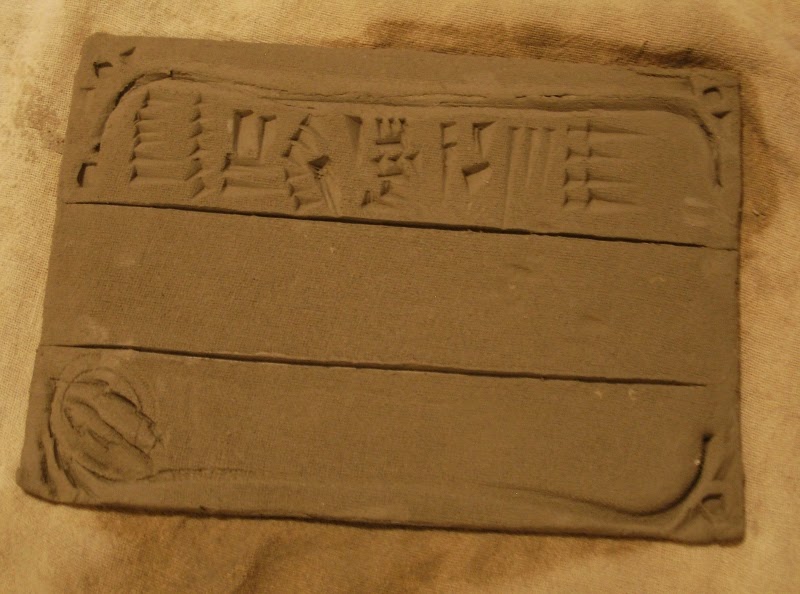
I still don’t. My tablet was a fun experiment. First I pressed a curved plastic lid along the edges to constrain the ‘text block’ and make it have a bit more eye-appeal. Then I pressed a metal set of leaves onto the lower left corner like a ‘seal,’ or stamped symbol. (When you work in clay you should always inscribe a mark that identifies your work.)


Next I drew along a straight edge with the stylus to divide the writing areas. In the top row I pressed the stylus into clay at many angles, sometimes lifting it higher and sometimes laying it almost flat. I also rotated the stylus so the wider edge was vertical and horizontal. It wasn't looking much like the triangular marks of cuneiform, so I watched the video again. I also reviewed some pictures from our Wikipedia reading.

Extract from the Cyrus Cylinder(lines 15–21),
giving the genealogy of Cyrus the Great and an
account of his capture of Babylon in 539 BC.

Phoenician alphabet

Sumerian inscription in monumental archaic style,
c. 26th century BC

I noted angles and direction of the imprints more carefully, and also noticed that for some of the broader marks the scribe pressed the stylus into the clay more than once at various different angles. I had better success when I tried again.


Then I tried to make ‘writing’ from different places and times on the second row. With my pocket knife, I shaped a smaller stylus with a longer narrower area to 'draw' or make longer marks.

trying other shapes and strokes with smaller stylus

The clay was a lot drier now and almost ideal to draw on and press marks into. It was somewhat stiff but still soft. On the third row I finally tried to mimic some of the letters/words pictured as cuneiform. Some were more pleasing than others; some were a mess. When I left it overnight to dry, it was the texture of leather and could be handled easily. 


This next morning I couldn't even tell it was drier, except that it was no longer like leather - it was stiff. It rained off and on today and my AC kept coming on – likely to remove humidity.

When making marbles it was important to keep them
similar in size to commercial marbles so that we weren't 
accused of cheating.

I got impatient, put the clay on a rack and turned my oven on low. I left the door ajar and set the rack above the open door. After a while, the top was getting fairly dry so I turned it over. The third time I did that it cracked along one of my dividing 'score' lines - maybe they were too deep.

Slip often becomes very 'creamy' but when the piece is dry
and baked only texture differences will be noticeable. 
It also dries more quickly.

I attempted to put ‘slip’ (a thin slurry of clay and water used to stick leathery unbaked clay to itself) on the back.


I wanted it to have the same texture as surrounding areas so I laid the cloth on it and pressed. DUH!! That was silly – and not patient. It broke in several places. That is when I remembered that a "slab" should have uniform thickness. To roll it to an even thickness you place it in between two matching slats of wood. You can also use a ‘form’ or ‘mold.'


I repaired the breaks using the slip and left it to dry. But I just couldn't seem to leave it alone. I moved it again and all my repairs came apart. Lucky for me I already had pictures. I had made it quite thin hoping it would dry quickly - maybe a bit too thin.


When clay is not baked, but has been shaped, it is called greenware. It is very, VERY fragile. I knew better than to move it around. My slab was in a very tender greenware stage, when just uneven finger pressure can cause damage. It was also not uniform in thickness, so even light pressure on the back caused it to crack. To handle a slab at that stage it would need to be moved lying on a flat surface. I didn't handle it properly.


When clay is baked it is much stronger. If this slab was properly fired it could be handled like any pottery plate of the same thickness. When glaze is added it is adds strength to the clay as well as a finish. This clay appears a deceptive soft- white gray, but when fired will become the common rusty, orange-red of a clay pot.


On some web sites showing cuneiform the tablets look much thicker than mine and show a more rounded sloping edge. This might make them much less fragile. If it is not baked, clay can also be recycled. As soon as water is applied, the clay readily returns to a lump that can be reworked.

soaking to become blended with main lump again

This has been a fun experiment and my tablet is going back into the lump – and likely, until my semester is over, back out to my craft room.

Shake a couple times and this is all just 'dirt' again. 
To reuse as clay I would stir and then let some moisture 
evaporate.