BOTTLED

  • “Sometimes the questions are complicated and the answers are simple. Dr. Suess

Sunday, May 6, 2012

CRUSTS OF BREAD

My mother baked 10 loaves of bread 3 or 4 times a week.
She raised 11 children. We ate a lot of bread.

photo courtesy of my daughter Kimber
she bakes a lot of bread for her family 
How many loaves do you think it would take to make 12 lunches most mornings (for dad and school)? And then give each of those lunch-eaters a 'snack' when they get home from school!

I love hot fresh homemade bread.
Let me rephrase ... I love homemade bread.
Being hot and fresh just makes it more edible.

By choice I would eat the crust in preference to the soft center. Many of my siblings feel the same way - too bad there are only 2 'heels' when so many vie for them. Mother taught us to share ... and take turns having the crusts at the ends of the loaves. I think she liked the middles - at least she sure gave her share away often enough ...

One way to share was to cut the crust in half; instead of one individual getting a large slice, two got a smaller piece. Another way to share was to 'gift' your part to someone. Mom instructed all of us about  the nobility of such an action - the giving of your piece (or turn for a piece) to someone else.

My spouse loves the soft, inner part of hot fresh bread. He prefers it to the crust. He likes crusts too, but when push comes to shove he chooses the inside. He has no contenders. I gladly 'sacrifice' and eat the crusts. If I insisted on sharing my crusts of bread he would be the one making the sacrifice.

I have one sibling that felt picked on if she was forced to have a turn eating the crusts. She never had to take her turn - she had lots of volunteers to pick from that were willing to trade. The real problem was only who she picked to 'exchange' her turn with and how often. Conversely another sibling only ate the middle after it was cooled a bit. He likewise never had any difficulty trading.

If I gave you the crust, would it be kind or mean? I most certainly would ask you which you want. I would be hoping you wanted the middle slices. At my grandmother's funeral some Uncles told about getting in trouble with their mom for opening the oven and pulling off the outside crust of the bread as it was baking.

Maybe a preference for crusts is genetic. I don't care for the soft inner center of the bread until it has completely cooled.

Bread from the store isn't quite the same. It is never warm and the crust is not very crusty ... usually more spongy. So in some homes it is the last slice eaten. I choose to eat it first.  It is at least as good as the other bread and I don't object. If you want to eat it I will gladly let you, however.

Is that a favor to you?
Or is it a sacrifice for me?

I asked my spouse that.
He waffled. He guessed it would depend our mutual desires.

He is correct, of course.
Our desires matter.

Desire motivates and inspires us to act - to love and hate; to share or shrug; to kindness or anger; to tact or cruelty; to laugh or cry at what we see, hear and feel; and especially to start or stop, endure or abandon, embrace or exclude given courses of action.

I think our perception matters as much, or perhaps even more, than our desire - if we think we 'have' to eat the crust or 'get' to enjoy it. If we feel we 'have' to share it or 'get' to give it.

How many other circumstances are like crusts of bread?
In what ways do I feel 'compelled'?
In what ways can I 'choose' to act?

Can I give you the benefit of a doubt? Can I believe you want to share the crust with me or do I think you are selfishly withholding it from me. Can I believe you intentionally sacrifice for my benefit when you give me the soft center because you perceive it as the best and most wonderful part? or do I think you are selfishly hogging the crust?

Can you believe that I ask if you prefer the crust or the middle not because I want the best part for myself but because I don't mind sharing?

And can you forgive me for sharing my 'crust of bread' - when you like the soft middle? And can you understand that sometimes I may only have crusts to offer?

Want to share a loaf with me?
It is all delicious!


Saturday, May 5, 2012

TWO PETITIONS - BOTH NEED SIGNATURES

Preserve Marriage Washington

Washington Referendum 74 (R-74) 
signatures must be submitted by JUNE 6, 2012;
--
UPDATE:  These petitions need to be in by 31 of May so that there is time to tabulate etc and get them where they need to be BY June 6.
Protect Marriage Washington

signatures must be submitted by JULY 6, 2012;

We, my husband and I, recently signed a petition to help maintain laws that preserve marriage as a relationship between 1 man and 1 woman by overturning the present governor's, (she who shall not be named) Marriage Equality LAW. 

We sought out a petition against the new law and signed it.
We patted ourselves on the back a little too soon.
Why is there always another wrinkle?
I suppose I should have realized it was too simple!

Yesterday we discovered there are two groups working towards the same outcome that do not seem to be associated with each other. For more details click links throughout this blog and read on ...  

At first we were confused ... are there two? [yes] had we signed both by signing one? [no] do both need to be signed? [yes]

There are other blogs and many other websites. Type in any of the titles or numbers to find your own links. I hope some of them help you learn more about these vital processes; opinions and responsiblities. 

I share below the reply to my husband from PROTECT MARRIAGE WA explaining the difference between the two:

Dear David,
Thank you for your inquiry. While we cannot speak for the R-74 people, basic marketing affirms that 2 are better than one. Having two similar items can actually build more interest as long as those in leadership support both. The synergy of two items can benefit both. We are actively supporting both petitions, R-74 and I-1192. Here is a brief [emphasis mine] explanation of the two pieces of legislation:
R-74 would allow us to vote on the same sex marriage bill that the Governor signed into law this last legislative session. When the signatures are gathered, the measure would be put on the ballot and we would vote to reject the legislation.R-74 is extremely important as it stops the same sex marriage bill until we have a chance to vote on it. If we do not get the signatures to get it on the ballot, we will have gay marriage in June.
 I-1192 strengthens the definition of marriage. It defines marriage as between one man and one woman and precludes everything else. The law previously has the definition as between a male and a female, which, unfortunately, in our present society is not a clear enough interpretation and we need language that specificl applies to human beings. Even if we did not have to fight the same sex marriage bill, we need the changes in I-1192. It also serves as a safety net should there be legal challenges to R-74 when it is passed.
Here are some differences between the two petitions:

First, Initiative 1192 was filed before the Governor signed the gay marriage bill into law... while the Referendum 74 had to wait to be filed until the gay marriage bill was signed.  Initiatives attempt to establish "new law", while referendums can only challenge existing laws. 
Second, both Initiative 1192 and Referendum 74 serve respective purposes.  1192 both strengthens our existing State Law as well as creates "new law" with the clarification in the language that will prevent gay marriage from being legal.  Ref. 74 challenges the same-sex marriage law with the intent to overturn it.  Ref. 74 also has the ability to suspend the gay marriage law (which is supposed to go into effect in June) until the voters have a chance to voice their positions in November.
Third, the language in Initiative 1192 has "positive verbiage"... in other words, it is clear to the reader that they are supporting (voting yes for) marriage to be between one man and one woman (based literally on the biblical model in Leviticus 18).  The language in Ref. 74, by law, must contain the wording from the gay marriage bill and will have "reject verbiage" in its description... for example, Ref. 74 might say something like "reject marriage equality and reject exemptions for religious institutions". 
In each case... we must clarify for voters that they simply need to remember to "VOTE TWICE for MARRIAGE" when they see 1192 and 74 on the November ballot.  Yes for I-1192 and Reject (R) for R-74
I-1192 was written by a lawyer and reviewed by the legal staff of several ministries and organizations. It was reviewed by the Secretary of State and met the requirements of Washington State before it could be distributed.
As soon as the R-74's were available, have had them at all of our events and encouraged everyone to sign both.
Fourth, the deadline for 1192 signatures is July 6th... the deadline for Ref. 74 is June 6th.
If you need any more information or would like copies of I-1192 or R-74,or if you need more information,  please feel free to contact us.


-Protect Marriage Washington

We will let you know if we learn anything new.
Watch for updates.
And please share any important information you know.


Tuesday, May 1, 2012

JOSEPH ARNOLD and JENETTE AMELIA AMES nee AUSTIN marriage and family

Joseph Arnold Ames
Jenette Amelia Austin

Married:
1 May 1882
Trenton, Cache, Utah, USA

Sealed: 9 November 1882
Endowment House, Salt Lake City, Utah

Joseph Arnold Ames family with all 9 living children. 
Circa 1904, William Henry Ames (Papa's grandfather)
 is on the back row at the far right.
Picture from Baron Family Web page - contacts not functioning

Papa's paternal great grandparents were members of The Church of Jesus Christ of Latter Day Saints -[referred to herein as 'the church'] . They believed that life began before their existence on earth and will continue after their existence here.

Their parents, (Clark and Frances Ames, and William and Agnes Austin) and some of their grandparents, experienced the rigors of pioneer travel and settlement as they moved west and established homes and communities.

These people also believed that God, as a loving father, provided a way for all of his children to obtain and have genuine happiness as part of everlasting existence and that every person may have all the joy/happiness that they sincerely desire. Their core beliefs helped them accept and endure many privations and sacrifices as they were asked to help colonize new areas several times.

Assignments often included moving their families and beginning to build again in another frontier area. They were also expected to be at peace and work with the people that might already be in those areas, including the nomadic Indians that might be friendly or hostile.

The 1860 Utah US census, page 222, shows several Ames families (including Joseph's father and grandfather) living in Brigham, Cache, Utah. A few pages later on page 245 we see William Austin and his family in the same place.

The 1870 Utah US census shows both families have moved but are in the same general area. Joseph is with his parent's and 7 siblings at Portage, Utah as described in a short biographical sketch below, and Jeannett Amelia with her parent's, 4 siblings and a house keeper with the same surname, is at Bloomington, Rich, Utah Territory (now partly Bear Lake County, Idaho). See map below.

Some descendants from the Baron family share a short history online that tells us a bit more about the family, [From the Salt Lake area the Clark Carter Ames family moved into the southern Utah 'Blue Grass Country', and from there to Portage, which was in northern Utah.] "He lived there for nine years. Each year they planted crops but were unable to harvest them, except for two years, because the grasshoppers and crickets were so thick. They dug trenches and filled them up with dry straw or weeds to make a sleeping place for the insects, then got up real early and burned them and killed many of the insects.

"[Joseph Arnold Ames] met his future wife, Jennet Amelia Austin while living there as her parents lived at Trenton just a few miles away [about 20 miles southeast] ." 

In 1880 Joseph, age 22, lived with his parent's and siblings at Trenton,Cache, Utah. Note that the father's profession is a farmer and all the boys in the family have 'laborer' listed as their profession. Pioneer children shared the heavy labor of establishing homes and obtaining the necessities of life from the prairies and mountains of western America with their parents.

1880 Trenton, Cache, Utah US Federal Census

The Austin family are also at Trenton in 1880. The census taker recorded Jennett Amelia's name as Janet. Her age is given as 14 on the June Census. Her birthday later that year in October would make her 15.

1880 Trenton, Cache, Utah US Federal Census

The couple were married 2 years later. The biographical sketch mentioned above tells us, "They were married 1 May 1882, and went to the Salt Lake Endowment House and were sealed to each other 9 November 1882, traveling there by covered wagon, together with another young married couple, bent on the same mission. It took them several days to make the journey. They had two sons born to them while living at Trenton." [Joseph Austin Ames,18 April 1883 and Hyrum Clark Ames, 29 May 1885]

Latter Day Saints [LDS] believe that for their family relationships to continue after this life that their marriages and families must begin with a covenant and promises not only between the couple but also between the couple and God. Such marriages are called 'Eternal Marriages'.

Adherents of the LDS faith believe authorized representatives of God, who have proper authority, must preform these covenant marriage ordinances. This is referred to as being 'sealed' together. Usually the sacred covenants of Eternal Marriage may only be made in a temple of The Church of Jesus Christ of Latter Day Saints. Sometimes when a temple was not available some (but not all) sacred ordinances could occur in another temporarily designated place.

When Joseph Arnold Ames and Jenette Amelia Austin began their family the nearest place an Eternal Marriage could be performed was in such a temporary structure, located in Salt Lake City 100 miles from the area where they lived. It was completed in 1855 and became known as the 'Endowment House'.


Salt Lake City Endowment House circa 1880

The nearest and only temple of the church was approximately 400 miles away at St. George, Utah. It was completed in April 1877. A temple in Logan, Utah ,only about 20 miles or a days journey, was under construction but it would not be complete until May 1884 - 2 years after they married. Another temple was being built in Salt Lake City, Utah, but would not be completed for another 10 1/2 years.

Temples were built with volunteer labor and donated materials for the most part. Men were assigned shifts to work. Women and children also helped in every way possible. On 18 May 1877 as work commenced on the Logan Temple, Church President Brigham Young is reported to have told the people at the dedication of the site, "We require the brethren to go with their might and erect a temple and from the architect to the boy who carries the drinking water and the men who work on the building, we wish them to understand that wages are entirely out of the question. We are going to build a house for ourselves and we shall expect the brethren and sisters, neighborhood after neighborhood, ward after ward, to turn out their proportion of men to come here and labor as they shall be notified . . ."

Another report states, "Roughly 25,000 people worked on the Logan Temple. Rocks and timber used for the temple were hauled from the Temple Fork area of Logan Canyon. As completion of the temple neared, women in the area were asked to make carpets for the temple, since commercially made carpet could not be bought in Utah at that time. The women spent two months working to hand make two thousand square yards of carpet."

Joseph Arnold Ames, Jennett Amelia Austin and their parents and siblings lived, worked, attended (and served in) the congregations of this place and era. We can be assured that they assisted in the work of these building programs. The names of Jospeh's father and mother, Clark Carter Ames and Frances Jane Beavans are inscribed on a memorial plaque to the pioneers of Bear Lake Valley inside the tabernacle at Paris Idaho.

A Cache County history tells us, "The construction of the [Logan] temple cost approximately $608,000.00. Of this amount the Church appropriated $37,000.00 and the people in Cache Valley and northern Utah donated the remainder in cash, labor and supplies. This was a great undertaking at that time and shows what can be done by strong determination and united effort. To construct the temple it took 1,000,000 feet of lumber, 256,000 cubic feet of rock, which weighed nearly 20,000 tons; 18,000 bushels of lime for mortar for the walls, 96,000 bushels of sand and 40,000 pounds of plaster of paris. 24,000 pounds of white lead for paint, 5000 pounds of rope to build and bind scaffolding, 24,000 pounds of nails, 13,000 pounds of metal for roofing and large quantities of glass for the windows were also used.

The Logan Temple will always stand as a monument of hard labor, sacrifice and sincere devotion to a cause of the early settlers of Logan and Cache Valley. Upon entering the Valley from any point it is the first object to greet the eye. It stands out in bold relief and at certain hours of the day when the sun’s rays strike it, it has a beautiful luster about it. Hundreds of tourists and strangers have praised its location and the style of architecture. It will always be … evidence of how well the early settlers in this section builded."


Frontier travel, whether 100 miles or 400 miles, was difficult and expensive, at best, and potentially fraught with many perils and hazards. A team of horses pulling a buggy or wagon usually traveled 15-20 miles per day. Note that this young couple made the arduous 100 mile trip to Salt Lake to solommize their marriage and be sealed together for time and all eternity 6 months after they were first married. Note also that November is after seasonal work such as planting and harvest, that families absolutely must attend to for survival, is complete.

In 1995 the Presidency of the church issued a proclamation to the world regarding doctrines about marriage and family. It states succinctly beliefs taught by The Church of Jesus Christ of Latter Day Saints throughout its history.

The proclamation says, in part:

"THE FAMILY is ordained of God. Marriage between man and woman is essential to His eternal plan. Children are entitled to birth within the bonds of matrimony, and to be reared by a father and a mother who honor marital vows with complete fidelity. Happiness in family life is most likely to be achieved when founded upon the teachings of the Lord Jesus Christ. Successful marriages and families are established and maintained on principles of faith, prayer, repentance, forgiveness, respect, love, compassion, work, and wholesome recreational activities."

A historical event this couple may have experienced soon after forming their family was reported thus in a special to the 10 November 1884 Deseret Evening News in Paris, Idaho:"Six distinct earthquake shocks were felt here this morning. The first, at seven minutes before two, was terrific and lasted over half a minute. Five other shocks, comparatively slight, occurred at brief intervals afterwards; the last at twenty minutes after four. The shocks were felt through the valley as far as heard from. Considerable damage to houses is reported, and some moveable articles were broken, although nothing serious occurred. People were affected as if by sea sickness. The movements of the first were severe shocks from northeast to southwest, and then a swaying motion from north to south. The others were from east to west.

The Salt Lake Tribune 13 November 1884 gave a much more flamboyant account: "This small berg and surrounding country was thrown into a fever heat of excitement by a terrible shock of earthquake. It began at 1:56 a.m. by a low, rumbling noise, accompanied by a slight trembling, sufficient to cause a rattling of windows, stoves, etc., and was followed in about 10 or 15 seconds by a most terrific shock, throwing books, dishes, etc., from their shelves and rocking houses to and fro almost akin to a vessel at sea. This was followed at exactly 2 a.m. or about four minutes after the first shock, by another shock much lighter than the first, and again at 2:53 another shock was felt, but was so slight as to be hardly noticeable.

"As the election of our President has been the all absorbing event of the world for the past week, it is quite safe to attribute this subterranean disturbance to the glaring error of the American people, but if the mere possibility of Cleveland's election should cause such a revulsion on the part of Mother Earth, what must we expect on the 4th of next March?" [The day he would take office].

Grover Cleveland's predecessor was Chester A Arthur. He took office when James A. Garfield was assassinated in the fall of 1881. A journalist Alexander McClure would later write, "No man ever entered the Presidency so profoundly and widely distrusted as Chester Alan Arthur, and no one ever retired ... more generally respected, alike by political friend and foe." He declined to serve a second term. One of the central issues in 1884 appears to have been corruption in politics.

In 1884 women had the right to vote but Jennett Amelia Ames was only 19. Utah Territory granted women that right in 1870. It was the second territory to do so (Wyoming also) and no state allowed women this right. The right was revoked by antipolyamy forces in 1887 and not won again until 1895, after much campaigning.

The new law was adopted with a constitution that would see Utah become the 45th state in the union on 5 November 1895 with a provision that "the rights of citizens of the State of Utah to vote and hold office shall not be denied or abridged on account of sex. Both male and female citizens of this state shall enjoy equally all civil, political and religious rights and privileges." They won a right granted at that time only in two states, Wyoming and Colorado. Idaho granted women this right in 1896.

Map of Pioneer Communities in Utah and Idaho 

The third child to join this young family was born in Mound Valley, Idaho. The Baron family sketch again enlightens us about the Ames family and their move to Idaho,"They then went up into Idaho where land was open to homestead. [Joseph Arnold Ames] homesteaded 160 acres in a valley which was called Mound Valley because of the many mounds made by Indian graves. He gave his father 40 acres of this land and a part of it for a school house and a church house. He also sold part of it to two brothers by the name of Bennet and retained only 40 acres of this land for his own use. He built a log house on it and there his oldest daughter [ Marcia Frances Ames] was born 2 February 1888. Seven more children were born to them while living there.

William Henry Ames, Papa's grandfather, was born in Weston, Oneida, Idaho (later Franklin County) 4 June 1890. He is the 4th child and 3rd son in his family. Our records say all of his younger siblings are born in Mound Valley: Amy Amelia Ames 17 July 1892, Leroy Ames 14 September 1894, Elmer Azel Ames 24 October 1896, Althea May Ames 27 March 1899, Ida Ione Ames 11 August 1902. Ella Lorene Ames, the youngest daughter, was born 8 October 1905 and died one year and one month later on 4 November 1906. She is buried in Mound Valley.

Draft cards for both WWI and WWII for Elmer and Leroy both state they were born in Cleveland, Idaho now a ghost town.

1 Joseph Austin Ames, 3 we think  is William Henry Ames,
6 a descendant thinks this is Marcia Ames,  
9 Joseph Arnold Ames,
10 Jennett Amelia Ames nee Austin, circa 1942

"[Joseph Arnold Ames] was active in civic matters. Being clerk of the Board of trustees for the school for many years he had the responsibility of getting the school district free of debt, hiring teachers and all things connected with the school. He was Superintendent of Sunday School for many years and always active in church duties. He had many talents superior to most.

"He was able to take a forked stick, hold it tight in his hand and locate wells for everyone in the valley. He located wells for nearly everyone for 50 miles around. By grasping the stick tightly he would walk over the land and the stick would turn toward the ground. He could tell them how deep they needed to go to find water. He was much in demand for measuring hay as he could always tell within a few pounds just where to cut for a ton of hay.

"He had a severe case of small pox and nearly lost his life at one time. He was always friendly and well liked by everyone. A traveler always could find food and a bed when they came to his door. He could talk to the Indians in their own language and they were all his friends.

Joseph Arnold Ames, left, with his son Hyrum Ames and his son 

"He was a ward teacher to the end of his days, never too busy to stop whatever he was doing to go teaching whenever he could get his companion to go. In the spring of 1919 he sold his farm and moved to Ucon, Idaho and bought 40 acres of land there. This he farmed until his health was so impaired that he couldn’t go on. He died there 6 March 1933 and was buried in Ucon, Bonneville County, Idaho, on 9 March 1933.

Sunday, April 22, 2012

FRANCES ALOIS HUCKINS history

-
Born: 22 April 1875, Neponset, Bureau, Illinois
Some records say Frances is born in nearby Peoria. 
-
Father:  James William Huckins (1843-1909)
 Son of Johnathan Crawford Huckins born 1802 
     and Abigail Aldrich born 1804
-
Mother: Mary Elizabeth Middleton (1856-1909)
Daughter of James Middleton born 1804 
     and Elizabeth Hisong born 1822
-
Fannie's father was born in eastern Canada at Montreal, Quebec. This area was also frequently referred to as 'Canada' [or previously 'Lower Canada', meaning closer to the mouth of the river - distinguished from 'Upper Canada' an area further 'up' the river]. 
-
Many early immigrates to North Amercia, especially from England, France and other areas of Europe, traveled up the St. Lawrence River and through the Great Lakes along the waterway chain connecting the east-central interior of North America to the Atlantic Ocean.
-
 Montreal was the furthest point  the largest vessels could reach at that time. The remainder of this 'highway', extending deeply through 2 of what became the largest Canadian provinces, connects 9 states along the US/Canada border. It was traversed in segments in smaller vessels.

Encyclopedia Britannica 2004 map showing Great Lakes and St Lawrence River
-
Wikipedia tells us, "People during the era routinely traveled huge distances, and the river was the principal route for people, supplies, arms, and commercial goods. Despite the need to portage past the Lachine Rapids, Niagara Falls, and other shallow rapids, the St. Lawrence was far easier to travel than rugged, inland routes. The importance of the St. Lawrence as the primary water route for shipping American goods westward receded with the opening of the Erie Canal in 1825, thus allowing a more southerly route stretching from New York City to Lake Erie to serve settlements in the Midwest." 
-
The population of this area included many immigrants. It also included many Loyalists that fled to Canada during the American Revolutionary War, and Native Americans that were expelled from the US at that time. The War of 1812 significantly impacted the area around the Great Lakes as the US declared war on Britain (Canada was a British territory) and poorly prepared and motivated American and British forces both captured and lost disputed territories. It was a war neither side really wanted or had the means or manpower to prosecute. Britain in particular was preoccupied with Napoleon and the French.
-
Fannie's mother was born in Elkhart, Indiana. It is just east of the southern end of Lake Michigan. That area and its many resources lie between the tips of Lake Michigan and Lake Huron and were commonly used by many Native American tribes well into the 1800's. 
-
From Richard Dean Taylor we learn: The village  platted as 'Elkhart' in 1832, near the convergence of 3 streams east of Lake Michigan had been 'fluidly' occupied by small Indian, trapper, and early missionary camps and settlements for centuries. It became the Town of Elkhart in 1859. Like many other river towns of the era it was situated on busy and well known trade routes with many heavily used trails and roads. Steamboat transport reached a zenith for a short few years and died out suddenly as the railroad arrived in the 1850's. "In 1850 the town had a 780 inhabitants and by 1870 2,053." Population and commercial interests expanded exponentially and in 1875 Elkhart incorporated as a city.
-
The Great Chicago Fire of October 1871, that killed and injured hundreds, and destroyed 3.3 square miles of the city of Chicago was one of the largest disasters of the 19th century in the United States . As the city was rebuilt it reshaped the economy of this region.
-
Fannie's parents were married in Stuart, Guthrie, Iowa 18 June 1871 (500 miles west of Elkhart) and their first child, a son they name Burton Blanchard Huckins was born there on March 10, 1872.  The family appears to be steadily migrating west.  
-
Neponset, where Fannie was born, is a small village in Illinois (about halfway between Elkhart and Stuart) with a total area of approximately one square mile, all of it land. The community was established in 1855 when the newly completed Central Military Tract Railroad (later renamed the Chicago, Burlington, Quincy Railroad) built a station there.
-
Soon afterward, the US Post Office was moved to Neponset from Brawby, a hamlet formerly located two miles north of the present village. It was named for the Massachusetts hometown of Myron Lee, the railroad's first agent at the Neponset station.
-
We do not know why Fannie's birthplace is contrary to the usual pattern and westward movement we see this family experiencing and 250 miles is a long way to go 'back east' by horse and buggy or wagon. We do know that she was born at a time when Railroads were rapidly expanding. This allowed people to travel much greater distances safely in more comfort and significantly reduced the time journeys took. Did they travel by rail? We do not know. Maps of railroads do show rail travel may have been available and did radiate out from the Great Lakes region, particularly near the southern areas of Lake Michigan.
-
Possible railroads that may have been available for use.
-
We see Fannie's siblings born further and further West. Eventually 4 brothers and 3 sisters (8 children in all) join the Huckins family. The youngest is born one year before she marries.

Locations of some events in Fannie's life. 
-
George Augustus Huckins 1877, Des Moines, Polk, Iowa;
Daisy D Huckins1879, Gray, Audubon, Iowa:
Cora (also called Corrie) Huckins 1881, Gray, Audubon, Iowa;
Alonzo Benjamin Harrison Huckins 1883,
       Hill City, Pennington, South Dakota;
Bertha Mabel Huckins 1885, Gray, Audubon Iowa;
Clarence Wilford Huckins 1889, Olreichs, Fall River, South Dakota.
-
1880 Cameron, Audubon County, Iowa
-
The 1880 census shows James and Mary Huckins living in Cameron, Audubon, Iowa with 4 children, 2 girls and 2 boys. It is about 12 miles west of Gray on the map above - so near that the locating tag for Gray disappears behind the tag for Cameron. Frances Alois is 5 years old. Her father is working in carpentry.

1885 Cameron, Audubon County, Iowa
-
The 1885 Iowa State census for Carroll, Warren County (26 miles south of Cameron - not on map above) shows Fannie A Huckins, age 10, with her parents and sibings. The birth place for her youngest sister, Bertha  Mabel Huckins born 15 January 1885, is listed as Gray. Her father is farming and is subject to military service and entitled to vote. Women in Iowa did not have the right to vote until Congress passed an amendment in 1919. There are columns to designate if people can read and write but not even one person on this sheet is checked - perhaps the census taker did not feel it was necessary information.
 -
Spouse: James Andrew McNicholl
Married 6 June 1890
-
In March 1910 her husband of 20 years died where they are living at Grangeville, Idaho. She is a widow at age 35. Her father died 8 months before then and on the census in June we see she is head of household in Washington State living with her daughters, 3 brothers, her mother and a nephew. 
-
She remarries a gold miner named Roy Dougherty (spelling varies) that has lived in her mother's boarding house while her father was the foreman of a mine on the Lower Methow in Okanogan County Washington. They live in California and Oregon. 
-
Died:17 May 1918, Weatherby, Baker, Oregon 
Buried: 1918 Malheur, Malheur, Oregon

Saturday, April 21, 2012

SUNSHINE CUPCAKES


'Bunny Corn' was .25 per bag after Easter.

sort out all the broken peices - kids will love to eat them for you

I wanted to try out these sunny cupcakes.
I bought a boat load of Candy Corn - and needed it!
Well, really only half of it ... do you need some?

Too much good sweet stuff! 
I made miniature cupcakes - 1 tsp of batter per cup - from a plain yellow cake mix that was on hand begging to be used up. I split it and only mixed half at once so I could bake them in stages. I whipped 2 eggs, 1/2 plus 1/8 cup water, and 1 Tablespoon of oil together and then added that to each cake mix part (measured in halves). Half a batch made 48 mini cupcakes.


I cooked some lemon pudding/pie filling and used a decorator bag to squirt it into the centre of each cupcake. Just plunge the point of the tip into the centre and squeeze - be careful not to overfill. This gave an subtle lemon flavor to the finished product.

I iced these with a bright lemon yellow butter cream frosting - made with butter of course! I always use about 2/3 butter and 1/3 shortening. Keep it spreadable but not thin.  And don't skimp on the coloring - put in LOTS! To achieve a shiny smooth-ish surface dip a flat edged table knife of spatula in a glass of warm water and swipe it across the frosting. Allow it to set slightly but not dry before decorating. Working with 3-5 at one time seems to work.


Now came the fun part. Drop on 2 mini chocolate chips for eyes - use your imagination and keep them near the centre-ish.


Snip off a chunk of 'peel-and-pull' red licorice - approximately 1 inch - more or less, and peel it apart. Because these cupcakes were so tiny I also snipped the licorice in half lengthwise with scissors.

Pinch on piece into a 'U' and  set it below the eyes (almost touching) for the smile.  Exact position will vary and add character.

This fellow was one of the first - I learned to make the 'U' more narrow 

Make sure to start with a tight 'U' as it tends to pop wider - it will 'relax' a bit.

Finally position a few candy corn to make sunshine rays around the perimeter of the cupcake.  Be sure to keep the base of each well onto the cake. TIP:  angle tip upwards (see left centre above). This will help them to not slip and droop - that was not fun to fix - not too hard though.

I preferred the look of fewer with a slight space
between fewer candy corn
If your candy corn are drooping or slipping off put them closer to the centre and use fewer that are spaced further apart. Drooping may also mean your icing is a bit too thin or soft. If they won't stick your icing is too dry - just put a small dot under each one.


The simplest way to transport these to an event is to carry them in the pan/s they baked in.

Notice not all of them turn out perfectly smooth -
the rougher guys  were eaten just as quickly though.

These were simple, inexpensive and fairly fast to complete.


Welcome back SUNSHINE!!


Friday, April 20, 2012

NEIL SNOW FORSYTH death

My father's father, my paternal grandfather, lived in our home in Kimball Valley, Alberta for a few years prior to passing away. I remember him well. He attended many family events and was generally of good cheer and was of sound mind.

August 1972 Garth Forsyth with his father
Neil Snow Forsyth - likely at Chrystal's blessing.
Grandpa would be 93. Notice how tall they are
compared to each other. Dad is about 6' tall. 
-
Grandpa Neil Snow Forsyth was fiercely independent and a hard worker. He was very strong even though he was not a large man. My father fills each minute with productive activity of some type. Once day Papa mentioned this to him. He scoffed and said, "My father could always do twice as much work as I ever could. Even when he was in his 70's he could out work me."

Neil's own history tells us, " May 24, [1964] I rented the Workman house to Barry Beamer for a year at $35 a month. I spent the next day fixing it up some. Then I did a small finishing job for Mrs. Able. It took me 4 days to finish and I asked Garth to come and pick me and my tools up on the 4th day. He and Jean came about 4 PM and I wasn't through so Garth stopped to help me finish. Mrs. Able went out and asked Jean in, but she said she would wait in the car. She started telling Jean how fast I was and how well I had done the work. Jean asked how old she thought I was, she said about 65. Jean told her I was 85 in Aug, she was sure surprised."

When Papa and I married my father was double Papa's age. Papa worked on dad's construction crew and said Dad could work circles around him and do twice or more the work of any man he knew ... he never knew my grandfather.

August 1976 - Ruth and Neil Snow Forsyth on his 97th birthday.  

Family often met at the Kimball Park near the St. Mary's River bridge in August to celebrate Grandpa's August birthday. His children and grandchildren that could, always came. On his 97th birthday 2 cakes cut into tiny pieces didn't go very far. He passed away less than a year later. His second wife accompanied him to that reunion and celebration. He married the widow, Ruth Spencer Rassmussen, 2 years after Grandma Chloe died. They traveled extensively and attended the temples together and generally shared the aging process for about 10 years. Her birthday was on August 10th.

Grandpa had one great and pressing agenda prior to his death. He wanted every person in the family to know the reality of Jesus Christ. He wanted to be sure each one of us personally heard and knew that he knew Jesus Christ is the son of God. He wanted us to know that the Church of Jesus Christ is on earth today as it was anciently (as described in the Bible). He wanted us to know that Joseph Smith was a prophet and that the Church of Jesus Christ of Latter Day Saints is true. He also especially wanted us to know that temple covenants and ordinances are for eternity - forever. He often spoke of Grandma Chloe and the 51 years they had shared. He told us these things many, many times.

age 95

My mother's sewing machine was tucked into a corner of the room that became his bedroom and living area. He was very hard of hearing but I would ask him to tell me about his life and he could sit for hours and do so. I was young and they were nice stories. I don't remember most of them.

One story I remember was about his grandmother Sally Adams. She knew Lucy Mack Smith, the mother of the Prophet Joseph. She told him about her experiences with that family and that they were good and honest people. She told him personal experiences about the translation and publication of the Book of Mormon and that she knew those things were truth. She was a reliably honest person. So was he. He was known, in the little town of Cardston where he kept a grocery store and a hotel, for his honesty and integrity.

Near the last of his life my grandfather needed special nursing care my mother and father were unable to provide he so was moved into the Cardston Auxilary Hospital, a long term care facility. He had always wanted to live to be 100 years old but as the indignities of aging took their toll he began to wish he might not. Whenever possible my parents would bring him out home for a visit - at first sometimes overnight and nearer the end of his life for increasingly shorter time periods.

Neil Snow Forsyth summer of 1975 about age 96

Grandpa Forsyth did not want to have a body that needed to be cared for like a baby. His keen and independent mind often rebelled. When he died it was a relief and blessing for everyone but oh how he was missed. It was like a part of our foundations of life were missing. He was ... he was ... well, he just WAS!


Cover of funeral program

Funeral program for Neil Snow Forsyth


-
Died:  17 April 1977 Cardston, Alberta, CANADA
Buried: 20 April 1977 Cardston, Alberta, CANADA
-

Thursday, April 19, 2012

DEAR RYAN

Happy Birthday!

Chocolate on Mother's Day is always a good choice ...

We hope your birthday turns out as good as the delicious food you so often make.  We appreciate your culinary skills and enjoy the many delicious meals you have welcomed us with.

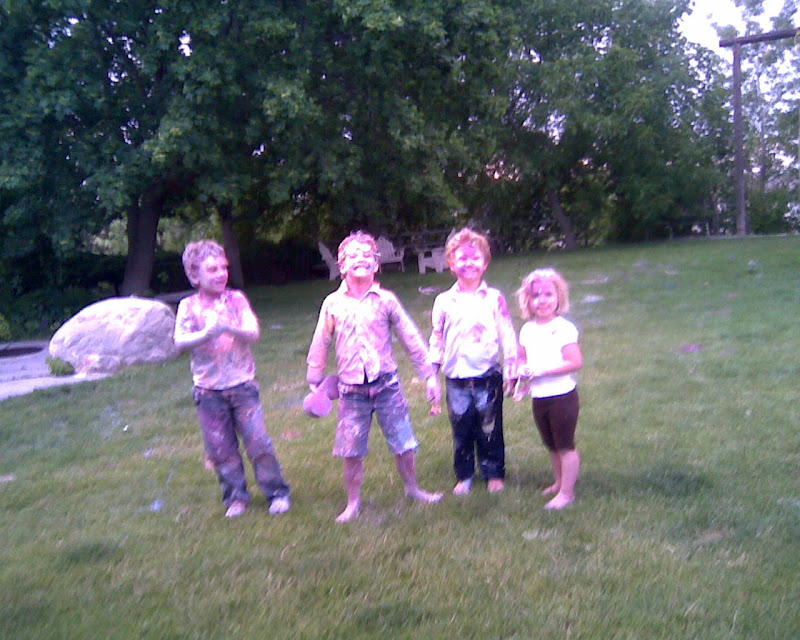
We have seen water fights but a 'real' paint was a first -
 glad you gave those kiddos goggles along with the sponges!!!

You make every visit memorable.

There are some we may never forget!


Thanks for being a wonderful and fun part of our family. And especially thanks for riding in the back with the  big slobbering dogs! You are amazing.

Wednesday, April 18, 2012

WILLIAM WARREN and PHOEBE ALICE CAMPBELL marriage and family

17 April 1900 is the day more than a century ago that, according to family records, my mother's grandparents were married.  Marriage records for Idaho indicate that they were married April 18, 1900 in Marion, Cassia, Idaho.
-

A very old fashioned song that I learned many years ago, titled 'Lavender Blue', comes to mind when I think of that time

Phoebe Alice Tolman and William Warren Campbell

Maybe it comes to mind because the first line starts with, "Great Grandfather met Great Grandmother when she was a shy young miss ..."
-
The words to the song may not be entirely accurate in this case because she had been married (see document at bottom), had a baby girl 18 June 1897, Ila Vera Clark, [that died 17 Feb 1899 at Marion, Cassia, Idaho] and was divorced [from Peter Clark] when Great Grandfather met her.
-
William Warren Campbell
Phoebe Alice Tolman
Married: 17 April 1900
Sealed: 11 Jul 1900 Manti, Utah Temple


My Grandfather, William David Campbell, wrote:
     "In 1897 [my father] got a job with a sheepman, William Tolman, whose daughter became my mother, Phoebe Alice Tolman. My father was with him during the sheep and cattleman war in Idaho. It was during this time that he met my mother.

"He went to Idaho in 1898 to work for William Tolman. It was at this time that the [sheep and cattleman] war went on and he told me how they would change their bed every night to a different position so that the head of the bed would be in a different direction for the cattlemen would shoot at the head of the beds.

"One cattleman told my Grandfather [William Tolman] he would shoot him on sight the next time he saw him. One day he was riding in a strange part of the range when he saw a cabin and when he knocked on the door a man opened it, reached up, up above it for a rifle and shot him. The bullet went through him, and then through the neck of the horse, killing the horse. Another horseman found him and took him home. It was six months before he could ride again.

"My father started to court my mother, Phebe Alice Tolman and they were married in the Spring of April 17, 1900. They decided to take the sheep camp wagon and started for Cardston, Alberta, Canada."


The 1900 US Census for Marion, Cassia, Idaho shows William Warren Campbell
with his wife Alice (heavy black arrow) living near his father and family
(lighter arrow) and other family (a sister and her family -Joseph Shurtz).

Howard K Campbell, son of Warren Earl Campbell, and grandson to William Warren Campbell tells some memories in a short family history published on the internet 13 October 2010. He writes:
     "In 1873 a report was made to the Dominion Government describing the west as being 'without law, order, or security for life or property'. As a result the North West Mounted Police was formed. In the year 1874 a force left Dufferin on the Red River travelling west looking for suitable locations for detachments. All Canada west of the Great Lakes was opened up by traders and settlers under the wing of the mounted police. Under this influence peace and security were the rule.

"Settlers moved into the Hill Spring District. In 1880 the Cochrane Ranch was founded by Senator Mathew Mullins. It was a going concern when the Mormon pioneers under President Charles Ora Card founded Cardston in 1887. 


"In 1906 the mormon church purchased the Cochrane Ranch. In 1908 President Wood started dividing this land for settlement. Seymour Smith was hired to survey the land and locate two townsites. One where Hill Spring now stands. A few people took the land in 1908 namely Drapers(built the first home in the district), Bill Wynder and William Tolman. In 1909 a few more families came, Alex Leishman and William Warren Campbell. Carl Tanner built the first home in the townsite in 1909-10. In June of 1910 President Wood came to Hillspring from Cardston. The people came from near and far. Among those present were F.P. Fisher family, Thomas Davies family, Carl Tanner family, Sid Tanner family, Allred family, Garner family, Alex Leishman family, W.C. Smith family, Hendrickson family, Richardson family, William Warren Campbell family and the Albert Tolman family.

"My father Earl Warren Campbell was born June 02 1910 in a one room house which his father later turned into a granery. He was the first baby boy to be born in Hillspring Alberta. On the 12th of June 1910 the ward was organized .The first school house was built in 1911. In 1914 the telephone was brought into the district. The sports were sponsored by the Mormon Church. Scout trips to Waterton Lakes. Badger holes his horse use to step in. His mother Phoebe Alice Tolman(Campbell) graduated from nursing school in 1917. Baseball and Track champions in 1930. Held the M.M. team cup in the Mormon Church till 1937. HillSpring was such a pretty place. He left Hill Spring in the fall of 1942. He was in the army services in World War 2. Trained boxer. Came to Vancouver British Columbia. Married my mother Eileen Mary Crandell(Campbell). Had five children(three boys and two girls)."


William David Campbell continues:
     "In 1900 they were in Cardston for a short time, then decided to go further north to Lacombe, Alberta. Here they homesteaded at Bentley in the same area as the Tolmans that were already there. In September they built a sod house and broke some land. I, William David [Campbell], was born in the spring of 1901 one year later and my brother [Laurence] Edward [Ted Campbell]was born in 1902" [at Lacombe]. Records on new.familysearch.org show, inaccurately, Uncle Ted was born in Idaho in 1899. Other family records state he was born 10 December 1902 in Lacombe.]

A 1906 Canadian census locates Phoebe's father William Augustus 
Tolman (midway down right side marked with black arrow) with 
his wife and 4 youngest children in the Province of Alberta, 
Strathcona District 37 B, section 24, township 42, range 2, meridian 5 
with a post office address of Rimby. He arrived in Canada in 1900 and 
owns 10 horses, 8 milk cows, and 4 'other horned or meat' cattle.

"At that time it was so wet for two years. The grain that was planted didn't ripen so they [his parents] decided to move back to Cardston. In 1905 they stated back in the same covered Wagon. On the way we camped by a bridge. I wanted to play on the bridge. Mother said, 'If you go on that bridge it will go up with you, that stopped me.'

"On the way it seemed like there were a thousand Indians. Sometimes my father was away from the camp to get the horses. That was when the Indians would come into camp to bother mother. She had my brother Edward in a baby carriage. The squaws wanted to take him out of the carriage. Mother always carried a six shooter. She got it out from under the pillow and started shooting in the air."


[Family records indicate that
Alberta Pearl Campbell was born 16 February 1905 at Rimbey Alberta. She lived most of her life in Idaho.]

"We arrived in Cardston in the fall of 1906 and my father started to work as operator of the Card Estate in Cardston until 1907. Then the Tolmans moved back to Cardston and built a new home there in 1907 and also a home on Belly River 3 miles south of where Hillspring is now."

[Parley Merlin Campbell was born
20 October 1907 at Cardston Alberta.]

"My father left the Cardston job and went to work for Grandfather Tolman freighting lumber from the Henery Hansen Saw Mill at Waterton Lakes. In 1909 my father bought 1/4 section of land on the East shore of Strawberry Lake south of Hillspring.

"We lost this farm and got another 1/2 section west of Hillspring on the Waterton River [abt 1918] ... In 1918 [my father] bought the Walter Caldwell place; 1/2 section North side of the lake.and lived there for 6 years.


Phoebe Alice Tolman Campbell

"In 1917 my mother, Phebe Alice Tolman Campbell, took a nursing course under Dr. Ellis R Shipley, a lady doctor. Mother was a wonderful person and served in her nursing night and day bringing a great number of babies into the world - while raising a family of 9 children, 2 girls and 7 boys."
Warren Earl Campbell was born June 2, 1910 - "the first baby boy to be born in Hillspring [Alberta] in 1910 ...",

Lowell Tolman Campbell was born
 December 5, 1912
at Hill Spring Alberta,

George Albert Campbell was born
March 17, 1916
at Hill Spring Alberta,

Ray Everett Campbell was born
July18, 1918
at Hill Spring Alberta.

Elsie May Campbell was born
May 3, 1921
at Hill Spring Alberta .

Except for Parley (note Elsie calls him by his middle name 'Merlin') who died at age 20 (1926) and Pearl who died at age 44, they all lived long lives.

"In 1919 the great drought began. [Bill is about 18 years of age.] We planted 200 acres of wheat and got 300 bu of wheat off the Stawberry Lake bed. That fall Dad bought a new double bedded wagon box. In June we took a load of wheat to Cardston…

"In 1919 and 1920 there was no feed in the country. Father and Marion Brooks each took a team of horses and went north to Cold Lake. All the rest of our animals died. We had 18 head of horses die. Cattle and pigs also. Marion Brooks had one cow. His son Willard Brooks and I butchered her."

My mother, Elna Jean Campbell, knew her grandparents and aunts and uncles, both the Campbells and the Tolmans. She says the Tolmans lived in Hill Spring on the next block. Mona Tolman, the daughter of George and Emily (Emma) Tolman (Phoebe's brother) was a cousin mom felt especially close to and spent a lot of time with.
Her Grandfather, William Warren Campbell, built the log cabin mom's family later moved into at Hill Spring. It was added to many times over the course of many years.

Mom says, "There was a dugout under the house. You went in from the outside. We kept fruit and vegetables and crocks of pickles in there.

"Phoebe Alice was around awhile. I knew her very little. I remember her more by picture than in person. He lived for quite a while after [she passed away.]... They always celebrated on the 1st of July. [He] owned the ice house. My dad had a 10 quart freezer and it stood about 2' high and about 15" across. They sold ice-cream at the ball games and they borrowed my dad's freezer.

"Something else interesting; my dad knew dynamite. He blew up wood for firewood. He would go out on the hills west above Hill Spring. He always blew up dynamite and everyone expected it of him every year. My dad's brothers sold salted peanuts out of old whiskey barrels everywhere, all over town ...

"We knew Uncle Ted and Aunt Jenny's kids really well. They lived up the Waterton river South West of my dad at Hill Spring. My aunts and uncles every once in awhile would have a reunion up on the Waterton River. That was while we still lived out on the farm till I was 5 or 6. [About 1935 or 1936.] Uncle Lowell lived 3 or 4 miles North West on a 1/4 section.

"When I was a teen I would get on a train [in Hill Spring] and go to Raymond to Uncle Ted and Aunt Jenny's. I went a lot and they put up with me. By then they were in Raymond. One of those kids married a Paxman ...

"In Hill Spring we had a town square all the families would walk there and just sit and visit. The Tolmans, Campbells, Davis', Fishers, Andrews or anyone else - would all get together and play ball, skip rope, Run Sheep Run. Uncle George and Aunt Emma were real singers and we sang all the way. We'd leave the church singing and sing 3 blocks home, whoever was walking home together.
"In Hill Spring there were trees around every block. The pioneers brought a piece of cottonwood and when you put it in the moist soil it would send up a shoot and grow. It could be almost any kind of tree - apple, whatever - a piece cut from a green tree and when there is lots of water it will grow. I don't know how they brought them. Look out there at Hill Spring. There are lots of trees - Merrills brought and dad helped plant them."

I often visited with Aunt Elsie Campbell Goy and I met many of her siblings - my mother's aunts and uncles. Elsie and I both lived in Lethbridge Alberta. Sometimes I took notes as she told me family history and stories. I now quote from bits of her memories, "When I was 4 or 5 I went on a train with my mother to her family and I started school when I visited there. When I came back [to Canada] I had to go back [in school]. 


1929 border crossing card for Alice Campbell and her daughter Elsie M.
on the CPR (Canadian Pacific Railway) shows that Alice was 5'9' tall, 
with a medium complexion, graying hair, and hazel eyes, and that they 
were going to her sister's Mrs. Geo Richardson in Pocatello, Idaho.

"Pearl's boyfirend teased the life out of me because I bit my nails. I also went to Salt Lake and visited my mother's sister there [Emily Althea Tolman Smith] and Etta [Mae Tolman married George Richardson] in Idaho too. 

"We had a reunion here [in Alberta] years ago. Mother's sister was in Claresholm - Aunt Clara [Clara Lovina Tolman Richardson] - her husband had died and she was by herself. I was about 13 at that time. Another came out from Pocatello Idaho. She had a daughter my age. Your Grandma [Elna Campbell] probably has it. I have pictures of the kids.

" Uncle Joel Shurtz [Joseph Francis Shurtz husband of Annie Elizabeth Campbell] wrote in my autograph book. They were very popular then you know. Everyone had one. I think I had written them [Joel and Beth]. Uncle Lowell [Tolman Campbell] (his wife is on oxygen now) lives close to Bride's Veil - he gets really enthusiastic ... had 2 girls. All the family [came].

" Another reason I remember those relatives [from the train trip] is they had a parrot. He sat on my knee and took a bite out of it. I can still remember the tabernacle from then.

"I remember my brother Merlin and he played the guitar and harmonica. I'd sit behind him and comb his hair."


While researching this family on the internet I found a picture of a 'Campbell Family Band'. Great Grandpa and Grandma are in the picture and he appears to have a harmonica in his hand. It is taken in LeGrande Oregon about 1937.

back row: Deward Winn, _______,
                 Rosetta Ann Campbell Schooler,  
                 Phoebe Alice Tolman Campbell,
                 Charles Wilbur Schooler, 
                 Susanna Campbell Winn Knapp,
                 Warren Campbell
front row: Jospeh Lester Schooler,
                 Joel Campbell,
                 Johnny Grant Schooler
-
A similar picture of the Campbell Family Band 

"There's a lot of hills in Burley. Now Joe Shurtz, they lived in a tent at the bottom of this hill. A circus came at the top of that great long hill and my dad was working out of the sheep ranch. They moved to Caldwell. Did anyone look in Rupert [for this family]? I think she had her little Joanne in Rupert.

with some siblings

[Once] "A knock came at the door - 'Are you Pearl Jamison?[Are you related to Ray and George?]' Anyway they got caught sneaking over the line, [the US/Canada border] and ended up in custody and not allowed to come across again. Pearl was there for years and years. When Pearl came back to momma's funeral then they wouldn't let them back across for about 3 months until she got a Visa. She was working. He was a printer.

"Ted and Jenny 
[Laurence Edward Campbell and Jenny Adelaide Brown] came out to care for me when mother and dad went down there [to help Pearl with some difficulties]. He [Ted] had a sheep ranch way up the river. Then they
moved to Raymond after that. 


A US/Canada border crossing card from 1936 shows
Wm Warren Campbell, age 65, traveling by car with his
wife Alice and son Earl, (and 3 other men - 
Mr. Haycock, Lowry and Gibbs) to Burley Idaho
to visit his daughter Mrs. Pearl Jamison. It also shows his
occupation is a farmer, that he is 5' 11" tall 
of medium complexion with grey hair and eyes.


-
"Earl had a car and he took mom and dad down to Pearl's. After mom and dad died we all split up and haven't come back together... I think of [my siblings]all the time. I've been here since 1949. In 52 when I was expecting, Will and Lowell came to see me in Raymond.


unknown couple may be Warren's brother Joel and spouse

"I lived in Saskatchewan. My husband's folks lived there when he was discharged. I went up to visit Earl and his wife Eileen [Warren Earl Campbell and Mary Eileen Crandall]. Uncle George married Emma Cheney [George David Tolman and Emily Louise Cheney].  I met her niece in Vancouver.  ... Margie Hugh Bates had 2 little boys and she said come and babysit for me. I'll pay you 4 $ a week - I couldn't make ends meet. I believe Bates would be a shirt tail relative. Eileen and I went down and I got a job at a cannery. She helped me. Then I was on my
own.

"I have my grade one diploma. I even have my birth certificate. I wasn't baptized until 1921 in Hill Spring. Your grandpa and Ted were born at the same place. Earl tried to write all that down. I have a photo stat. It's faded but you can make it out.

William Warren Campbell's sons - left to right
Ray Everett Campbell;
George Albert Campbell;
Lowell Tolman Campbell;
Warren Earl Campbell;
Laurence Edward [Ted] Campbell 
William David Campbell far right

"I've got a picture Ruth gave me of my family. When Aunt Jennie [Adelaide Brown, Ted's wife] died they took a picture of all of us [1980]. I went walking in and stood at the end of this group and all the sudden they took the picture. I decided,'I'm not going to stand at the end. I ran around and stood in the middle. They've all got a grin trying not to laugh because I did that.

William Warren Campbell's children - left to right:Ray Everett Campbell; George Albert Campbell; Lowell Tolman Campbell; Elsie May Campbell Goy;Warren Earl Campbell;Laurence Edward [Ted] Campbell;William David Campbell 

"Will was as straight as he could be. When he laughs his head goes way back and then out it comes, so loud! My dad laughed like that too. Will standing there trying to keep it in with a big grin. Ray named a boy Warren.


"Pearl lived in Burley. My dad and I went to Burley with the Rasmussens after mom died. I was 17. He went to the sheep ranch to visit his brother. I didn't go. I stayed with relatives. They were 7th Day Adventist and lived in a trailer. When we'd sit down for prayer at this relatives we visited, I stayed with them and even started school, I was crying and they was crying and I guess they was trying to convert me. They don't believe in TV and Christmas."
Aunt Elsie thought these were the relatives that had the parrot.


I found a border crossing card for both Elsie and her father in 1939. They traveled with friends Thomas T. Mendenhall, his wife Nita and Emily Lee and Iona Mendenhall to Pearl's in Burley Idaho by car. Elsie is 5' 6 1/2" tall at age 17 with light brown hair and brown eyes. She can read and write and has been in the United States before.
-
note that this card has his signature at the lower left

He has 40 dollars cash and intends to remain 6 months. This card also documents that he arrived in Canada at Whiskey Gap, Alberta about 1900.

The back of the card notes under the heading 'Medical Certificate', "wife died 2 months ago and desires to make a visit to get away from surroundings at home." 

Although it appears he perhaps had some difficulty crossing the border it is clear he was surrounded by loving family and friends at a difficult time. This family did much more than laugh and sing together. They loved one another.


documentation for previous marriage